


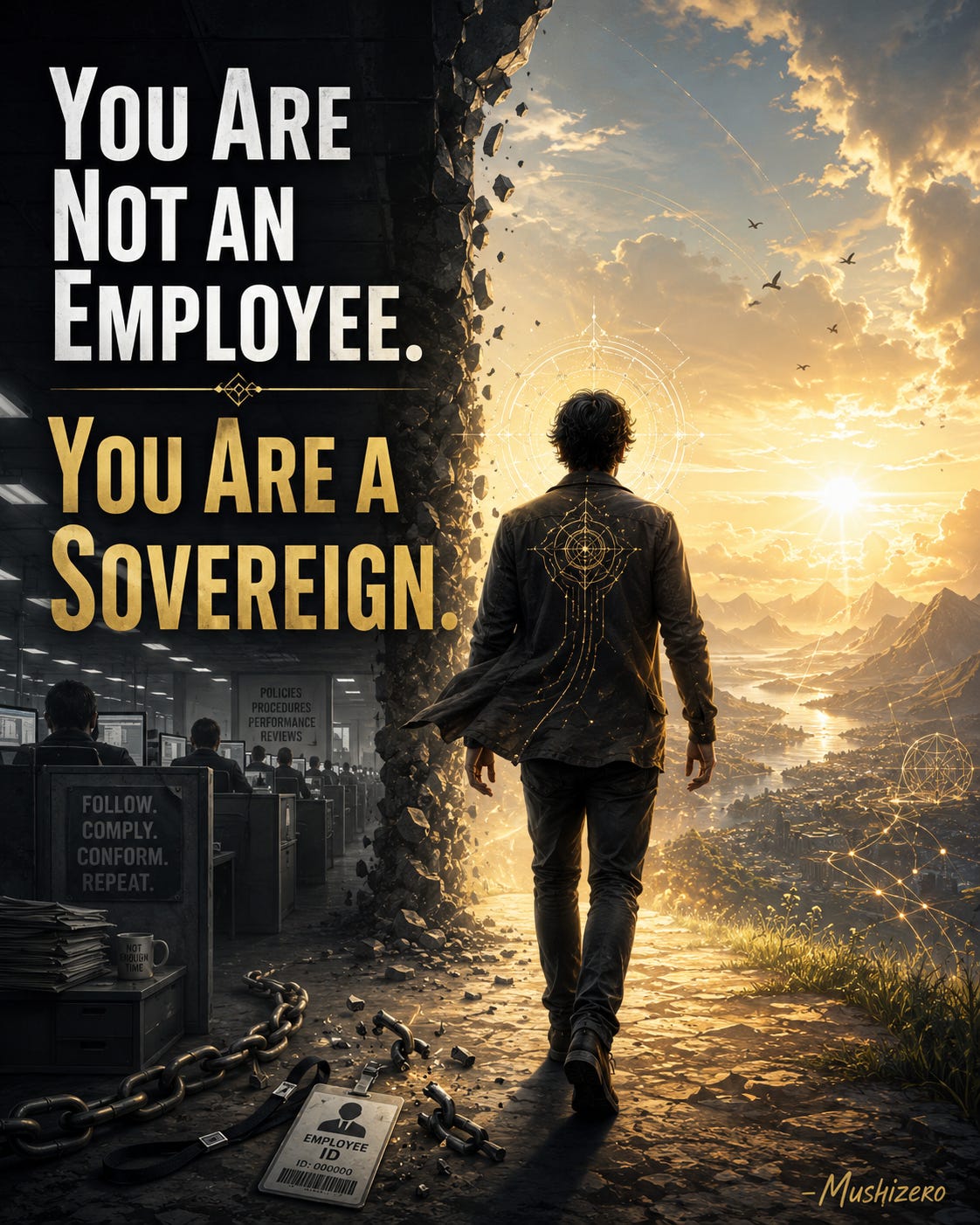
Reclaiming a word the industrial age took from you.
Before there were employees, there were sovereigns.
The word predates the factory, the office, and the org chart by roughly a thousand years. Sovereign, from the Latin superanus, meaning “above,” described someone who held authority over their own ground. A sovereign owned the means of their own production. They held title to the land they worked, the tools they used, the apprentices they trained, and the reputation they built. They paid tribute to higher sovereigns sometimes, traded with peer sovereigns often, and took commissions from clients regularly. But the locus of authority sat with them, on the soil they stood on, in the workshop they had built with their own hands.
This was not a privilege of the nobility. The word reached far down the social ladder. The medieval miller was a sovereign of the mill. The blacksmith was a sovereign of the forge. The midwife was a sovereign of her practice. The scribe was a sovereign of the scriptorium. The relationship between commoner sovereigns and their work was structurally similar to the relationship between kings and their kingdoms, smaller in scale and identical in form. They held title, they held tools, they held knowledge, they held succession. Their children inherited the workshop. Their apprentices inherited the methods. Their names were on the door because the door was theirs.
Then came the factory.
The industrial transaction
The industrial revolution did something specific and historically novel. It separated the worker from the means of production. The blacksmith who had owned his forge became the factory hand who rented his labor to the man who owned the new, larger forge. The seamstress who had owned her needle and her clientele became the operator of a sewing machine she did not own, producing garments for customers she would never meet. The scribe became the clerk. The midwife became the nurse. The miller became the millhand.
The economic logic was efficiency. Industrial-scale capital, including steam engines, rail networks, telegraph lines, and electrified factories, was simply too expensive for any individual craftsman to own. Concentration of capital meant concentration of authority. The worker traded sovereignty for access to machinery they could not afford. The factory owner provided the machinery in exchange for a controlling share of the worker’s economic output.
The word for the new arrangement had to be invented. Employee enters English in roughly its current sense in the 1820s, just as the factory system reaches maturity. It is the linguistic shadow of employer, defining the worker entirely in terms of the entity that hires them. Before the 19th century, the standard ways to describe working people, including craftsman, journeyman, apprentice, master, practitioner, smith, wright, referenced their craft. After the 19th century, the standard way to describe working people referenced their employer. That shift is not cosmetic. It is the linguistic record of who now holds authority.
Two hundred years later, the vocabulary remains. The conditions that produced it do not.
What the industrial bargain gave you, and what it took
The industrial transaction was not a swindle. The worker who entered the factory got real things in exchange for what they gave up: predictable wages, access to capital they could not personally afford, the protection of belonging to a larger entity that could absorb risk the individual could not. Over the next century, that bargain was extended and improved through hard fights, including labor unions, the eight-hour day, weekends, paid leave, pensions, healthcare benefits, and anti-discrimination law. By the mid-20th century, the employee identity offered a deal that, on net, looked reasonable to most people most of the time. Stability for sovereignty. Security for autonomy. A career for a craft.
But the deal was always conditional on a single underlying fact: the firm owned capital you could not own yourself. That was the premise that made the trade rational. Surrender authority over your work, in exchange for access to machinery, infrastructure, and scale that no individual could replicate.
Hold that premise in your mind, and then look at 2026.
In the last twenty-four months, the premise has quietly broken.
An individual professional can now credibly own the means of their own cognitive production. A lawyer can own the equivalent of a research department. A doctor can own the equivalent of a diagnostic stack. An analyst can own the equivalent of a modeling infrastructure. A writer can own the equivalent of a publishing house. The hardware sits on a desk. The models are open-weights. The corpus is the professional’s own work product. The fine-tuning stack is freely available. The scale that used to require a firm now fits in a backpack.
This is the first time since the early industrial revolution that the capital-concentration logic has reversed. The factory no longer owns something you cannot own yourself. The firm’s monopoly on the means of professional production is ending, not because of regulation, not because of revolution, but because the cost curve crossed.
When the premise that justified the bargain disappears, the bargain disappears with it. The vocabulary is the last thing to go.
The brain-scrapers know
The companies running brain-scraping operations, including Meta with MCI, Mercor with its expert-recording marketplace, and the Chinese platforms cloning workflows into agent manuals, understand exactly what window they are operating in. They are racing to extract sovereign-grade cognition from professionals before those professionals realize they could simply be sovereigns again. Every keystroke captured, every reasoning trace recorded, every workflow documented is an attempt to convert your cognition into the firm’s capital before the cost curve makes that conversion unnecessary for you.
This is not paranoia. It is a coherent corporate strategy with a closing window. If individual professionals reach sovereignty before the scrapers reach saturation, the scrapers lose. If the scrapers reach saturation first, professionals enter the next era as captured cognition rather than independent operators. The race is real. The professionals are mostly not aware they are in it.
The vocabulary is the camouflage. As long as you call yourself an employee, you accept the frame in which someone else is the principal and you are the input. The brain-scraping makes perfect sense inside that frame. It makes no sense outside it. The sovereign frame is not a metaphor. It is the accurate description of what you can now be, and the inaccurate description of what you currently call yourself.
What sovereignty meant then, what it means now
Map the medieval sovereign craftsman to the 2026 sovereign professional, layer by layer:
Land then, hardware now. The miller owned the mill site. The smith owned the forge. The sovereign professional owns the hardware their model runs on, whether laptop, server, or colocated box. The land was the precondition for production then. The hardware is the precondition for cognition now.
Tools then, models now. The wright owned the lathe. The scribe owned the quill and the inkpot. The sovereign professional owns the model, open-weights, fine-tuned, configured. The model is the active instrument; the hardware is the ground it sits on.
Materials then, corpus now. The weaver owned the wool, the dyes, the raw stock. The sovereign professional owns the corpus, including notes, decisions, drafts, transcripts, and the lifetime accumulation of work product that the model is fine-tuned against. This is the input the cognition operates on. It is also the asset that compounds.
Apprentices then, agents now. The master had apprentices, extensions of the master’s practice, trained in the master’s methods, executing under the master’s authority, eventually becoming sovereigns of their own shops. The sovereign professional has agents, extensions of the professional’s practice, trained on the professional’s corpus, executing under the professional’s authority. The form is identical. The technology is different. The continuity of structure across a thousand years is striking once you see it.
Guild then, federation now. The medieval sovereign was not isolated. They belonged to a guild, a federation of peer sovereigns who shared standards, defended members against bad-faith counterparties, resolved disputes, certified competence, and provided collective bargaining power against the powerful. The sovereign professional needs the same thing. Federations of peer operators, with shared norms, shared discovery infrastructure, shared defense against the platforms. The guild is not an artifact of medieval economics. It is the natural organizational form of sovereign professionals in any era.
Charter then, treaty now. The medieval sovereign held a charter, a written instrument that established their rights, jurisdictions, and relationships with other sovereigns. The sovereign professional writes treaties, contracts with clients that specify what the client gets (the deliverable), what the operator keeps (the brain, corpus, fine-tunes), and how disputes resolve. The charter and the treaty serve the same function: they make sovereignty legible and enforceable.
The mapping is not poetic. It is structural. The thing that ended in roughly 1820 can begin again in roughly 2026 because the conditions that made it possible, namely distributed ownership of the means of production, have, for the first time in two hundred years, been restored at the level of cognition.
The objections, old and new
Sovereignty arguments draw the same pushbacks they always have. Each one was answered before, and is being answered again.
“Most people can’t own the means of production.” This was true in 1850, when steam engines cost a fortune. It became less true through the 20th century as small-business capital fell. It is false in 2026 for cognitive work. The hardware costs less than a used car. The software is open-source. The barrier is no longer capital. It is identity.
“You’re just describing freelancing.” Freelancing is a 20th-century construct, selling labor by the hour to multiple buyers under terms set by platforms or industry norms. Sovereignty is older and structurally different. The medieval sovereign craftsman was not a freelancer. They held title, controlled methods, owned succession, and operated inside a guild. The sovereign professional in 2026 has the same five layers, modernized.
“What about benefits, healthcare, retirement?” These are real. They are also the artifacts of the industrial bargain, specifically the part where firms absorbed risks individuals could not. In a sovereign frame, these become priced inputs that the operator carries themselves or pools through federations, which is exactly how guilds handled equivalent risks in their era. The current US healthcare system is a real obstacle to sovereignty. It is not an argument for staying inside a frame that’s converting your cognition into someone else’s inventory.
“This sounds like nostalgia for the medieval craftsman.” It isn’t nostalgia. It’s recognition that the industrial era was a parenthesis in a much longer history of distributed sovereign professional work. For roughly ten thousand years before factories, professionals owned their work. For roughly two hundred years inside the parenthesis, they didn’t. The parenthesis is closing. What comes after is not a return to the past. It is a continuation of what was always normal, equipped with the tools of the era it lands in.
Where this goes: a near-future worth describing
Project the trajectory ten years out and the picture sharpens.
By 2035, in a world where the sovereignty trajectory wins:
Professional licensing bodies, including bar associations, medical boards, and engineering societies, function more like medieval guilds than industrial-era credentialing offices. They certify sovereign operators, defend members in jurisdictional disputes, set standards for what counts as a legitimate personal brain, and run discovery infrastructure that lets clients find sovereign professionals without going through scraper-platforms.
Most senior professional work is done by sovereign operators in federations of three to thirty. The large firm survives but as a coordination layer, assembling teams of sovereigns for specific engagements, taking a coordination fee, owning none of the underlying cognition. The firm becomes the general contractor; the sovereigns are the master craftsmen on the job.
Employment as a category survives mainly for early-career operators (the modern apprenticeship) and for genuinely industrial-scale work where capital concentration still makes sense, such as running a hospital, operating a fab, or flying an airliner. The professional class above the apprenticeship tier is mostly sovereign.
Personal models and personal corpora are inheritable. A sovereign passes their kit to a chosen successor, a child, an apprentice, or a junior partner, the way a master craftsman once passed the workshop. The succession is not metaphorical. It is a contractual transfer of weights, corpus, and federation membership.
“AI” is no longer the topic of breathless news coverage, because it has dispersed into the kit of every sovereign professional rather than concentrating in a small number of hyperscalers. The hyperscalers still exist. They are utilities, not landlords.
Project the trajectory in the other direction, where the scrapers win, and the picture also sharpens.
By 2035, in a world where brain-scraping wins:
The professional class as a coherent category has effectively dissolved. Cognition is rented from a small number of platforms that own the models that own the captured judgment of the previous generation of professionals.
Employment exists, but as gig-tier piecework. The credential is gone. The career ladder is gone. The pension is gone. What remains is a sequence of short engagements training the next model that will replace you.
A small minority of holdouts, sovereigns by historical accident, operate at the high end, charging extreme premiums to clients who specifically need cognition that is not platform-derived. They are exotic, expensive, and viewed with suspicion by mainstream business.
Bias and training failures accumulate in the captured-cognition stack until the platforms produce systemic errors that were always present in the corpora but invisible inside the homogenized output. The corrections require sovereign professionals who no longer exist at scale. The damage is real.
These two futures are both coherent. Both are reachable from where you stand right now. The vocabulary you adopt is one of the variables that determines which one arrives.
The deeper move
The provocation is not “become a sovereign.” The provocation is recognize that you already could be, and the only thing stopping you is two centuries of industrial-era language describing a bargain whose underlying premise just expired.
You inherited a vocabulary built for your great-great-grandparents’ economy. Your great-great-grandparents accepted that vocabulary because the bargain it described made sense in their lifetimes. You are running their software on your hardware. The hardware has changed. The software has not.
The medieval sovereign did not have a special temperament. They were not unusually brave or unusually entrepreneurial. They were ordinary professionals operating under ordinary conditions of distributed production. Sovereignty was the default, not the exception. The factory made sovereignty the exception. The personal brain makes it the default again.
Your great-great-grandfather the blacksmith would not have understood the question “are you an employee or a sovereign?” To him, the question would have parsed as “do you have a forge or do you not?” If you had a forge, you were a smith. If you did not, you were an apprentice working toward having one. There was no third category.
The third category was invented in 1820. It served a purpose for two centuries. The purpose has now expired.
Act accordingly
You can keep working. You can keep collecting a paycheck. You can keep the lanyard. None of that is the point. The point is the identity from which you do those things.
Build your forge. Curate your materials. Train your apprentices. Join your guild. Write your charter. Pass your kit to your chosen successor.
Do these things and the word employee will become, for you, what it has always actually been: the name of a temporary arrangement inside a longer history, useful when its premises hold, discardable when they don’t.
The premises don’t hold anymore.
You are not an employee. You never really were. You are a sovereign, recovering a word, and a way of working, that was yours before the factory took it.
Act accordingly.
This is the third in a series. The first argued that self-hosted personal brains are the only durable answer to AI brain-scraping. The second argued that polymaths are the special forces of the AI-era firm and that their personal brain is their kit. This one places the whole argument in its proper historical scale: the industrial-era employee identity as a two-century parenthesis inside ten thousand years of sovereign professional work, now closing. The deeper case for the principle traces back to John Wolpert’s How to Own Your Brain at Work. Start there if you haven’t.
Fascinating ideas. Ideas which move society forward in a pro-social way are usually the ideas grounded in experience and proven workability like the guild system. On a local scale, the old idea of co-ops could work for hospitals and small factories, especially in rural areas. Co-ops give the workers soveriegnty because they own and run the endeavor.
Couldn't agree more. Beautifully written. I hope we're on the right track with things like https://residualknowledge.net