


Take 3
Not every failed merger outcome begins with a bad decision. Well-intended people can make locally rational decisions that collectively defeat enterprise intent.
The decision chain does not operate in a vacuum. Authority, incentives, information, systems, time, resources, risk, defaults, and legacy structures form a constraint field around every link.
Before blaming the individual, test the environment. If the observed behavior was rational under the constraints presented, changing the person may simply reproduce the same result with somebody else.
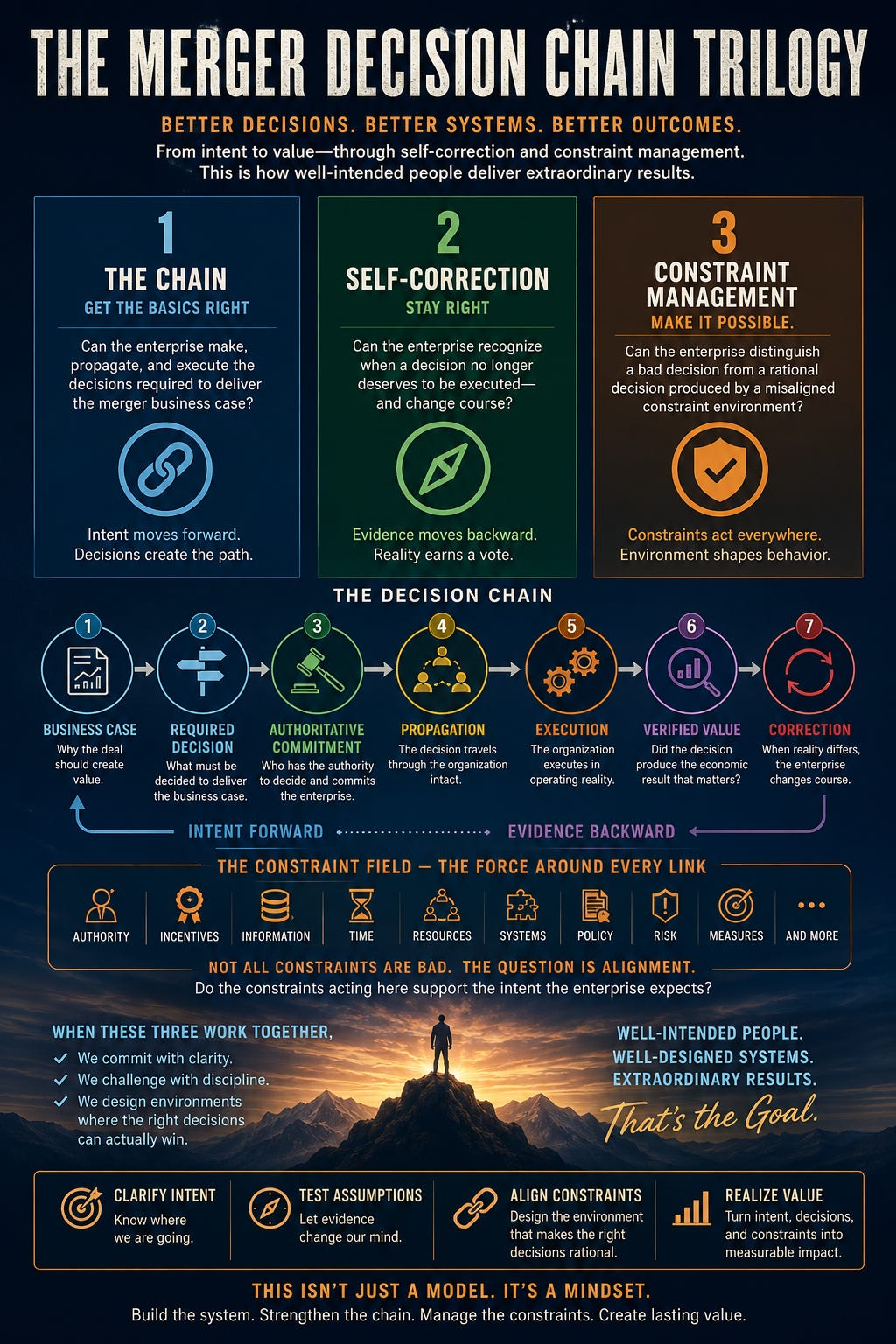
In the first piece, I asked:
Can the combined enterprise make, propagate, and execute the decisions required to deliver the business case for which the merger was approved?
That produced the decision chain:
Business Case → Required Decision → Authoritative Commitment → Propagation → Execution → Verified Value → Correction
The next expansion came from a useful challenge by Meir Amarin:
“What would make us change our mind?”
That exposed another failure mode.
A decision chain can function perfectly and still become an extraordinarily efficient machine for executing the wrong decision.
So the chain needed another dimension.
Intent moves forward. Evidence must move backward.
Every consequential decision should carry the conditions under which the enterprise is prepared to reconsider it.
But there is another problem hiding underneath both models.
What if the decision was reasonable?
What if the individual understood the intent?
What if they were acting in good faith?
And what if the behavior that ultimately undermined the merger was still the most rational behavior available to them?
Now we are somewhere different.
We are in the territory of constraints.
The Individual May Not Be the Weak Link
Consider a familiar post-merger instruction:
Cross-sell the combined portfolio.
The strategy makes sense.
The executive team has approved it.
The decision has propagated.
The regional sales leader understands exactly what management wants.
And then cross-selling barely happens.
The conventional diagnosis begins quickly.
Resistance.
Legacy thinking.
Poor leadership.
Culture.
Failure to embrace the merger.
Maybe.
Now examine the environment in which the regional leader is actually deciding.
Their compensation still disproportionately rewards legacy-product revenue.
Their quota was established before the integration workload appeared.
The CRM does not provide complete visibility into acquired-company accounts.
Customer ownership remains disputed.
Cross-selling creates additional approval requirements.
Their regional P&L absorbs implementation costs while enterprise leadership receives the synergy benefit.
Their quarterly performance remains measured against targets that assume business as usual.
And they have 90 days to deliver.
Now ask the question differently:
Given those constraints, what is the rational local decision?
Perhaps exactly the behavior management is calling resistance.
That changes the diagnosis.
The individual may not be the weak link.
The system may be loading the link in a direction opposite to the force it expects the link to transmit.
The Chain Has a Countervailing Force
I previously described the merger decision chain as the mechanism through which business intent becomes operating value.
I still think that holds.
But the chain is only half the model.
Running against it is a constraint field:
Authority
Incentives
Information
Time
Resources
Systems
Policy
Ownership
Risk
Performance measures
Defaults
Legacy commitments
Local economics
Social norms
Cognitive load
These forces act on every link.
That gives us a more complete model:
Intent → Decision Chain → Behavior → Value
while simultaneously:
Constraints → Decision Space → Behavior
Intent says what the enterprise wants.
The chain attempts to transmit it.
Constraints determine what choices are actually available and attractive to the people expected to act.
This is not an argument for eliminating constraints.
That would be absurd.
Constraints make organizations governable.
Authority boundaries protect the enterprise.
Controls manage risk.
Budgets create discipline.
Policies create consistency.
Systems create repeatability.
The question is not whether constraints exist.
It is:
Are the constraints acting on the decision compatible with the intent that decision is supposed to serve?
That is the constraint-management problem.
Cognitive Science Makes This More Interesting
There is a tendency in management thinking to treat the individual as an independent decision engine.
Give the person the right strategy.
Communicate clearly.
Assign accountability.
Measure performance.
Then expect the right decision.
Cognitive science gives us good reasons to be skeptical of that model.
Human decision-making is not independent of the environment in which it occurs.
It is deeply shaped by it.
Bounded Rationality: Nobody Sees the Whole Merger
Herbert Simon’s work on bounded rationality challenged the assumption that people optimize decisions using complete information and unlimited computational capacity.
They cannot.
People operate with limited:
information;
attention;
time;
computational capacity;
and knowledge of future consequences.
So they simplify.
They satisfice.
They make workable decisions from the information and alternatives available to them.
That becomes particularly important in a merger because different people inhabit radically different informational environments.
The board sees the acquisition thesis.
Corporate development sees valuation and diligence.
The Integration Management Office sees dependencies.
The business-unit leader sees operating targets.
The regional executive sees a P&L.
The frontline manager sees customer complaints, headcount, systems permissions, quota, and Friday afternoon.
All can make internally coherent decisions.
And collectively produce an incoherent enterprise outcome.
The problem is not necessarily that one of them is irrational.
They are solving different versions of the problem.
Ecological Rationality: Rational Relative to What?
The work of Gerd Gigerenzer and others on ecological rationality pushes this further.
The quality of a decision strategy cannot always be judged independently of the environment in which it operates.
A simple heuristic can perform extremely well when it fits the structure of its environment.
Move that same strategy into another environment and performance can deteriorate.
That gives merger integration an interesting problem.
Before the merger, a manager may have developed highly effective rules:
Protect the customer relationship.
Escalate unusual contracts.
Prioritize the core portfolio.
Control discretionary spending.
Stay within the regional P&L.
Use trusted internal specialists.
Those behaviors may have helped make the acquired company successful.
Then the merger changes the strategic intent.
But unless the surrounding environment changes with it, the old behaviors may remain locally rational.
The organization says:
Act like one company.
The environment says:
Your compensation, authority, data, budget, workflow, systems, and risk still belong to the old one.
Which signal wins?
Often, the environment.
Defaults Are Decisions Someone Else Already Made
Behavioral science adds another useful insight.
Defaults matter.
A substantial research literature on choice architecture shows that changing the default can materially alter behavior.
That has a direct organizational analogue.
Suppose leadership announces:
We are now one enterprise.
But the default operating environment remains:
legacy systems;
legacy account ownership;
legacy approval paths;
legacy incentives;
legacy reporting;
legacy access controls;
legacy budgets.
Management has communicated one choice while architecting another.
Every time an employee wants to behave according to the new intent, they must overcome friction.
Every time they follow the legacy path, the system helps them.
Eventually the organization calls the resulting behavior “culture.”
Sometimes it is.
Sometimes it is simply choice architecture.
Time Is a Constraint on Cognition, Not Just the Project Plan
Mergers run against the clock.
Synergy commitments have dates.
Markets continue moving.
Employees want certainty.
Customers react.
Investors expect progress.
So management applies pressure:
Move faster.
But time pressure is not neutral.
Research on decision-making under time constraints shows that people change how they gather and evaluate information when time becomes scarce.
They simplify.
They reduce exploration.
They rely more heavily on available cues and familiar strategies.
That can be adaptive.
Now place that inside a merger.
We compress the timeline.
We preserve the complexity.
We introduce unfamiliar systems.
We change authority.
We add new counterparts.
We create uncertainty.
Then we are surprised when people retreat toward familiar legacy behavior.
What management interprets as resistance may sometimes be an entirely predictable cognitive adaptation to the environment management created.
“Move faster” is therefore not merely a schedule decision.
It changes the decision architecture.
Expertise Is Also Environment-Dependent
Gary Klein’s work on naturalistic decision making is relevant here.
Experts frequently make effective real-world decisions under uncertainty and time pressure without comparing every conceivable option.
Experience allows them to recognize patterns and rapidly simulate plausible actions.
But mergers change the environment in which those patterns were learned.
A highly effective executive from Company A may suddenly encounter:
unfamiliar authority;
different escalation paths;
new risk tolerances;
different data;
unknown counterparts;
changed incentives;
conflicting operating assumptions.
The executive did not suddenly become less intelligent.
The environment supporting their expertise changed.
Their previously effective pattern recognition may now be operating against a different system.
That is another reason to be careful about labeling post-merger behavior as competence failure too quickly.
Sometimes the person is failing.
Sometimes the fit between expertise and environment has failed.
Human Factors Gives Us a Better Diagnostic Question
Safety science has wrestled with a similar problem for decades.
Sidney Dekker and other human-factors researchers have challenged the tendency to treat “human error” as the end of an investigation.
If the analysis stops at:
The operator made a mistake
we have explained very little.
A more useful question is:
Why did that action make sense to the person at the time?
What did they know?
What could they see?
What were they trying to accomplish?
What competing goals existed?
What constraints were operating?
What did the system make easy?
What did it make difficult?
That does not remove accountability.
It improves diagnosis.
Translate the same idea into merger integration:
What looks like execution failure from headquarters may have been a locally rational response to the system headquarters created.
That deserves investigation before the enterprise changes the person.
A Merger Is a Distributed Cognitive System
There is another implication.
The relevant decision-maker may not be an individual at all.
A merger distributes information and authority across:
boards;
executives;
integration teams;
functions;
business units;
geographies;
systems;
external advisors;
customers;
suppliers.
No single participant possesses the complete state of the enterprise.
The combined company is effectively being asked to think as a distributed system.
That means coordination matters as much as individual intelligence.
A brilliant CEO cannot personally resolve every local contradiction.
A brilliant regional leader cannot see every enterprise dependency.
A brilliant IMO cannot possess every piece of customer knowledge.
The system must somehow produce coherent behavior from distributed information and distributed authority.
This is where my earlier argument around Intent Coordination becomes relevant.
The problem is not merely transmitting strategy downward.
It is preserving intent as that strategy crosses organizational boundaries while allowing local adaptation without allowing local optimization to silently redefine the enterprise outcome.
Constraint management adds another layer:
What forces are shaping that local adaptation?
Three Failures That Look the Same on a Dashboard
This gives us a distinction I think merger governance needs.
1. Decision Failure
We chose the wrong course.
The business case or operating assumption was wrong.
The answer is reconsideration.
2. Execution Failure
The decision was sound, but we failed to carry it through.
Authority, coordination, capability, discipline, or implementation broke.
The answer is execution repair.
3. Constraint Failure
The intended behavior was reasonable, but the surrounding environment made another behavior more rational, available, or survivable.
The answer is not necessarily a new strategy.
And it is not necessarily a new person.
The answer may be changing:
incentives;
authority;
information;
defaults;
systems;
resource allocation;
performance measures;
time expectations;
ownership;
policy.
All three failures can produce the same red KPI.
They require different interventions.
That is why diagnosis matters.
Constraint Management Is Not Constraint Removal
This point deserves emphasis.
The goal cannot be:
Remove whatever prevents people from executing.
Some constraints exist precisely because they should.
A merger synergy target does not justify bypassing cybersecurity controls.
A growth objective does not eliminate legal obligations.
Integration velocity does not automatically trump customer commitments.
The more useful distinction is between constraints that are:
Required — necessary boundaries the enterprise intends to preserve.
Inherited — remnants of the pre-merger organizations.
Conflicting — individually valid constraints producing incompatible behavior.
Misaligned — constraints that actively reward behavior contrary to current intent.
Unknown — constraints visible only when execution reaches the operating edge.
Constraint management therefore means making these forces visible and deciding deliberately which should remain.
Sometimes the correct result is:
The constraint wins.
And if that reduces the achievable merger value, the business case must absorb that reality.
That is preferable to pretending the value remains available while blaming operators for failing to produce it.
The Constraint Test
I would add a simple diagnostic to the toolkit.
For any material merger decision:
1. What behavior does enterprise intent require?
Be specific.
Not:
Collaborate.
But:
Regional sellers should introduce acquired-company Product B into qualifying Company A accounts.
2. What behavior is the environment actually rewarding, enabling, or forcing?
Look at reality.
Compensation.
Systems.
Authority.
Risk.
Time.
Metrics.
Information.
Budget.
3. What constraints define the individual’s decision space?
Do not ask only what the employee should do.
Ask what they can actually do and what happens to them when they do it.
4. Given those constraints, is the observed behavior rational?
This is the uncomfortable question.
If the answer is no, we may have an individual performance problem.
If the answer is yes, keep going.
5. Which constraint—not which person—needs to change?
That is the pivot.
Because replacing a rational actor while preserving the same constraint environment often produces the same behavior with a different name on the organization chart.
Now Put It Back Against the Chain
The model has evolved.
Business Case
What value are we trying to create?
Constraint question: What assumptions limit whether that value is actually available?
Required Decision
What must be decided?
Constraint question: What limits the available choices?
Authoritative Commitment
Who decides?
Constraint question: Does formal authority match actual authority?
Propagation
Can the decision travel intact?
Constraint question: What incentives, interpretations, information boundaries, or legacy structures alter it along the way?
Execution
Does operating behavior change?
Constraint question: Does the environment make the required behavior rational and possible?
Verified Value
Did the economics materialize?
Constraint question: Which constraints explain the gap between intended and observed value?
Correction
What changes?
Constraint question: Are we changing the decision, the execution—or the environment producing the behavior?
That last distinction may be the most valuable.
Intent Forward. Evidence Backward. Constraints Everywhere.
The visual model now changes again.
Intent moves forward.
It tells the enterprise what outcome it wants.
Evidence moves backward.
It tells the enterprise whether reality agrees.
Constraints act everywhere.
They determine what movement is actually possible between the two.
That gives us a three-force system:
Intent provides direction.
The decision chain transmits force.
Constraints shape movement.
And people operate inside all three.
This Changes the Leadership Question
It is easy to say:
Hold people accountable.
And accountability matters.
But good leadership also asks:
What exactly are we holding this person accountable for overcoming?
If the enterprise gives someone:
contradictory incentives;
incomplete information;
insufficient authority;
incompatible systems;
unrealistic time;
competing objectives;
and then judges them solely against enterprise intent, management has externalized its own design problem onto the individual.
That is not accountability.
It is poor diagnosis.
The counterpoint matters equally.
Constraint analysis must not become an excuse generator.
People still make poor decisions.
Some leaders resist change.
Some actors protect territory.
Some lack the required capability.
Some knowingly optimize against enterprise interests.
The principle is therefore not:
The system is always responsible.
It is:
Before attributing failure to the individual, determine whether the system made the observed behavior locally rational.
That is a much harder standard.
And a much more useful one.
A Toolkit, Not Another Transformation Program
As with the decision chain itself, I would resist turning constraint management into another enterprise framework to install whole cloth.
Organizational maturity remains the limiting factor.
Some organizations are ready to model decision rights and incentives systematically.
Others are not.
Some can instrument evidence flows.
Others need to begin by asking one simple question in a review meeting:
What made this decision make sense to the person who made it?
That may be enough to expose the first hidden constraint.
The tools can remain simple:
Constraint mapping
Decision-rights analysis
Incentive alignment
Assumption registers
Premortems
Change conditions
Evidence thresholds
Choice-architecture review
Local-versus-enterprise value analysis
Constraint classification
Use the tool that fits the failure.
Do not install architecture the organization cannot sustain.
The Next Merger Question
The original question was:
Can the combined enterprise make, propagate and execute the decisions required to deliver the business case for which the merger was approved?
Then came:
Can it recognize when one of those decisions no longer deserves to be executed?
Now I would add:
Can it distinguish a bad decision from a rational decision produced by a badly aligned constraint environment?
That distinction changes the intervention.
And potentially the outcome.
Because the person closest to the failure is not necessarily its cause.
Sometimes the decision was wrong.
Sometimes execution failed.
And sometimes the enterprise created an environment in which good people, acting rationally and with good intent, repeatedly produced exactly the behavior the system made sensible.
If we want different decisions, telling people to decide differently is not always enough.
We have to understand the environment making the current decision rational.
Intent tells the enterprise where it wants to go.
The decision chain carries that intent.
Evidence tells us whether reality agrees.
Constraints determine what people inside the system can rationally do about it.
Manage all four, and we have something approaching an adaptive enterprise decision system.
Ignore the constraints, and we may continue replacing people for behaving exactly as the system taught them to behave.
References
Amarin, Meir. “Arrogance vs. Conceit: Who Wins?” LinkedIn, 2026.
https://www.linkedin.com/pulse/arrogance-vs-conceit-who-wins-meir-amarin-qjvaf
Dekker, Sidney W. A. “When Human Error Becomes a Crime.” Human Factors and Aerospace Safety, and related work on the “new view” of human error. Dekker’s broader human-factors research develops the systems-oriented argument that error should be understood in the context in which behavior made sense.
Gigerenzer, Gerd; Gaissmaier, Wolfgang. “Heuristic Decision Making.” Annual Review of Psychology, Vol. 62, 2011, pp. 451–482.
https://doi.org/10.1146/annurev-psych-120709-145346
Gigerenzer, Gerd; Todd, Peter M.; ABC Research Group. Simple Heuristics That Make Us Smart. Oxford University Press, 1999.
Johnson, Eric J.; Goldstein, Daniel. “Do Defaults Save Lives?” Science, Vol. 302, 2003, pp. 1338–1339.
https://doi.org/10.1126/science.1091721
Jachimowicz, Jon M.; Duncan, Shannon; Weber, Elke U.; Johnson, Eric J. “When and Why Defaults Influence Decisions: A Meta-Analysis of Default Effects.” Behavioural Public Policy, 2019.
https://doi.org/10.1017/bpp.2018.43
Klein, Gary. “Performing a Project Premortem.” Harvard Business Review, September 2007.
https://hbr.org/2007/09/performing-a-project-premortem
Klein, Gary. Sources of Power: How People Make Decisions. MIT Press, 1998.
Simon, Herbert A. “A Behavioral Model of Rational Choice.” Quarterly Journal of Economics, Vol. 69, No. 1, 1955, pp. 99–118.
https://doi.org/10.2307/1884852
Staw, Barry M. “Knee-Deep in the Big Muddy: A Study of Escalating Commitment to a Chosen Course of Action.” Organizational Behavior and Human Performance, Vol. 16, No. 1, 1976, pp. 27–44.
https://doi.org/10.1016/0030-5073(76)90005-2
McKinsey & Company. “How the Best Acquirers Excel at Integration.” 2016.
https://www.mckinsey.com/capabilities/strategy-and-corporate-finance/our-insights/how-the-best-acquirers-excel-at-integration
McKinsey & Company. “Eight Basic Beliefs About Capturing Value in a Merger.” 2019.
https://www.mckinsey.com/capabilities/people-and-organizational-performance/our-insights/eight-basic-beliefs-about-capturing-value-in-a-merger
Christofferson, Scott A.; McNish, Robert S.; Sias, Diane L. “Where Mergers Go Wrong.” McKinsey Quarterly, 2004.
https://www.mckinsey.com/capabilities/strategy-and-corporate-finance/our-insights/where-mergers-go-wrong
Pieraldi. “Intent Coordination: The Business Case.” Red Shirt Brigade / Substack.
https://open.substack.com/pub/redshirtbrigade/p/intent-coordination-the-business