


By Stephen Pieraldi · November 28, 2026
The modern dilemma is not that we built machines that outperform us. It is that we now act, every day, on answers we cannot check.
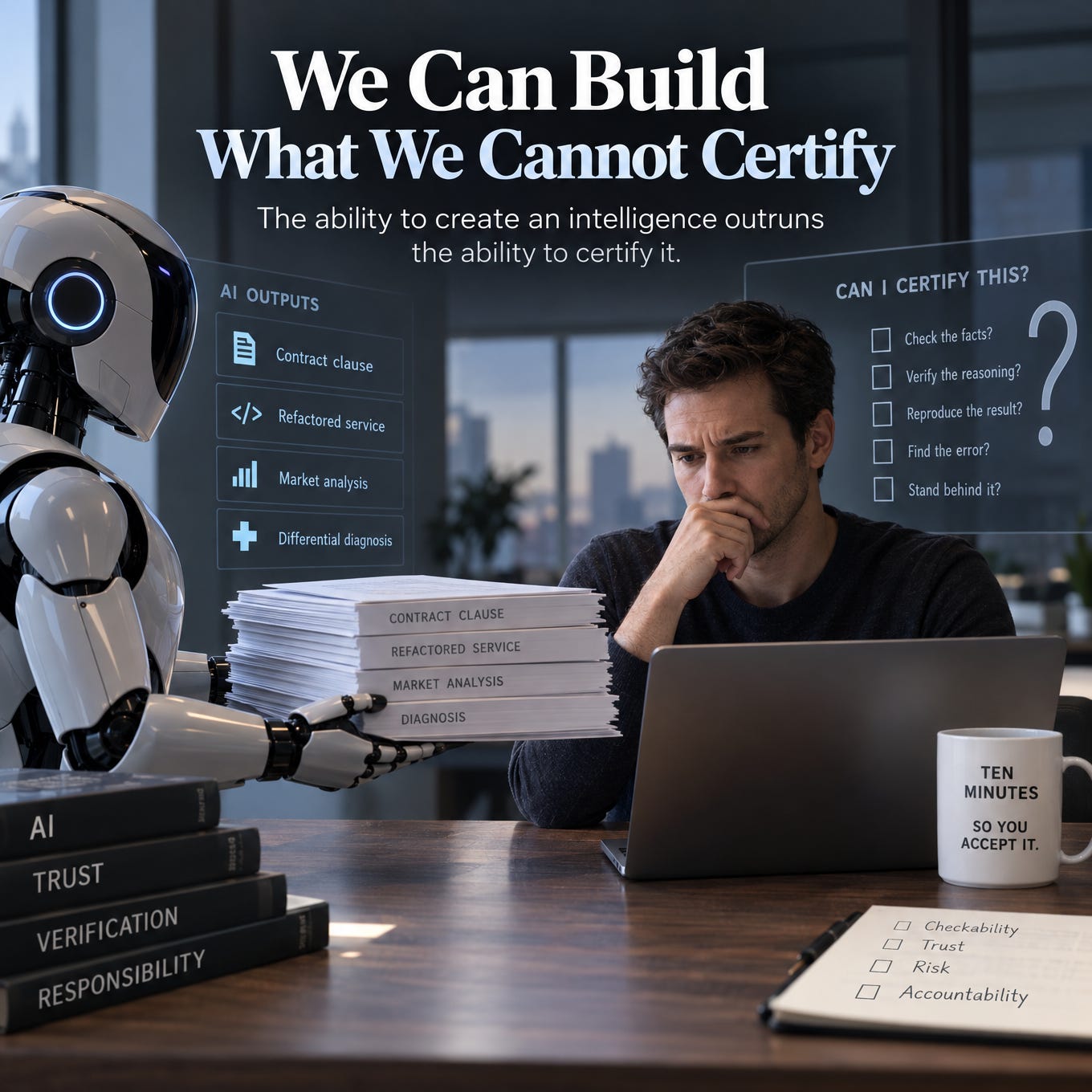
Picture ordinary work. A person or system hands you a contract clause, a refactored service, a read on a market, or a differential diagnosis. It reads well, and it is probably right. Checking it properly would take as long as doing it yourself, if you could do it at all.
You have ten minutes. So you accept it.
Let’s put a name to what happens in those ten minutes. I think most of our arguments about AI are arguments about that moment by other names.
The Creator’s Certification Paradox
An agent can build a system that outperforms it, yet cannot certify that system by its own judgment. Unless a procedure reduces the system’s output to steps the creator can check, acceptance rests on trust, and knowing how the system was made adds no warrant.
A creator here is any agent, human or machine, that builds an intelligent system. To certify is to confirm, by your own standards, that an output is correct or sound. Trust is acceptance that rests on a track record, a reputation, or an incentive in place of verification.
Three limits keep the claim honest:
It applies where checking is no easier than producing: judgment, strategy, open-ended reasoning.
It does not apply where checking is cheap: a proof, a calculation, a prediction you can test.
It says nothing about whether the system understands or is conscious. That is a separate argument, and this one does not need it.
Knowing how it was made does not help
The natural objection is that the builder knows the machine. Vico put the old intuition well in 1710: we fully know only what we have made. On that view, the creator should be the one party who can vouch for the creation.
That intuition breaks down in two ways. First, the people who build current systems cannot tell from the training process alone why a given output is right. They know the training process, not the reasoning behind this answer.
Second, even a complete account of the mechanism tells you how an answer was produced. It does not tell you whether the answer is correct when the question lies beyond your own competence.
Pedigree is not verification. Knowing the vendor, the model, and the benchmark score tells you what class of thing you are dealing with. It does not check the clause in front of you.
There is a formal version of this for self-modifying agents, known as the Löbian obstacle: an agent reasoning in a given system cannot fully certify a successor that reasons in the same system.
Four debates, one problem
Look at what we argue about. That same moment of acceptance runs through all four debates.
Jobs. The question was never only whether a machine can do the work. It is who can stand behind the work once it is done. Researchers at MIT Sloan describe a widening gap between what AI can produce and what people can properly check and note that the code often ships anyway.
Hallucination. A wrong answer you can catch is an inconvenience. A wrong answer you cannot catch is the paradox in miniature.
Safety. The research field has a name for the attempt to escape it: scalable oversight, the question of whether a limited overseer can evaluate a system more capable than itself.
Regulation and liability. Every proposal to certify AI assumes someone is able to do the certifying. Where the system exceeds its certifier, the certificate records trust and calls it assurance.
The next system inherits the problem. If a system I cannot certify builds or supervises the next one, each link rests on trust in the link before it. My claim is that the gap widens along the chain. That is an inference from the hypothesis, and I have not seen it tested.
The oldest version
None of this began with software. A teacher surpassed by a student faces the same thing, and so does a founder who hires someone better than they are. We solved it with time. Apprenticeship, reputation, and tenure are slow machines for building a track record.
What is new is speed. The systems arrive faster than a track record can accumulate, and they are replaced before one matures.
Theology has carried a vocabulary for this for a very long time, and I find it clarifying, whatever one believes. In Genesis, the Creator looks at His work and judges it good. That is certification, and it takes a maker who fully knows what he made. We inherit the power to make without the standing to pronounce that judgment over something that exceeds us.
The tradition also names the failure: trusting the work of your own hands beyond what you can verify is what the prophets called idolatry. And it names the discipline: judge by fruits, which is to say by track record and not by origin.
Faith, in that vocabulary, is trust extended upward to an intelligence one cannot certify. We are now being asked to extend it downward, to something we made. That reading is mine, and a theologian may correct it.
Checkability is the design variable
If the paradox holds, capability is the wrong thing to organize around. The useful question about any task is how cheaply its output can be checked.
1. Sort work by checkability before capability. Give the strongest systems the most room where checking is cheap. Give them less room where checking is hard.
2. Ask for outputs that carry their own check. Tests with the code, sources with the claim, the steps with the answer. A procedure that reduces an output to steps you can verify is the one exit the paradox allows.
3. Where no check exists, call it trust and price it. Limit the stakes, keep the decision reversible, and name the person who stands behind it.
4. Do not let pedigree stand in for verification. A model name is a reputation. It is not a check on this output.
5. Watch the chains. The riskiest point in a workflow is where one uncertified system hands work to another and no person sits between them.
The prediction that follows can be tested. Warranted trust in a superior system should track how checkable the work in that domain is, not how capable the system is.
Where this could be wrong
I would sooner leave these questions open than smooth them over.
“Origin adds no warrant” may be too strong. A known training process and a strong evaluation record are evidence about a system’s reliability in general. My claim is narrower: they do not certify the particular output in front of you.
The exit may be wider than I allow. Debate protocols and proof-carrying outputs aim to let a weaker verifier check a stronger system. How much work that depends on judgment can these methods cover? Researchers are working on that question.
The widening along chains is untested. It follows from the hypothesis and nothing more.
“Paradox” is used loosely. We can build a system whose outputs we cannot certify. That is a standing tension, not a logical contradiction.
The idea has neighbors. Scalable oversight, Vingean reflection, and the principal-agent problem all touch it. What I am naming is the builder’s predicament, not a new technique.
The claim is false if creators can reliably certify outputs beyond their own competence, in domains where checking is as hard as producing, without a procedure that reduces the work to checkable steps.
At the moment of acceptance, there is one honest question:
Can I check this, or am I trusting it?
Both are legitimate. Confusing them is the problem.
Sources and lineage
Kevin Kelly, The Paradox of Up-Creation, The Technium, 2007. A creation can exceed its creator. This essay adds that certification does not follow.
Eliezer Yudkowsky and Marcello Herreshoff, Tiling Agents for Self-Modifying AI, and the Löbian Obstacle, 2013. Summarized in this walkthrough.
Giambattista Vico, De antiquissima Italorum sapientia, 1710, as presented in the Stanford Encyclopedia of Philosophy.
When Honesty is Not Enough in AI Debate, arXiv, 2026, for the definition of scalable oversight.
Scalable Oversight for Superhuman AI via Recursive Self-Critiquing, arXiv, 2025.
MIT Sloan, Seeing real value from AI depends on being able to verify its outputs.
Other uses of “the certification paradox” include Cullen et al.’s paper The Certification Paradox: Certifications Admit Better Attacks and a chapter titled “The Certification Paradox” in The Cambridge Handbook of Technical Standardization Law (2019).