


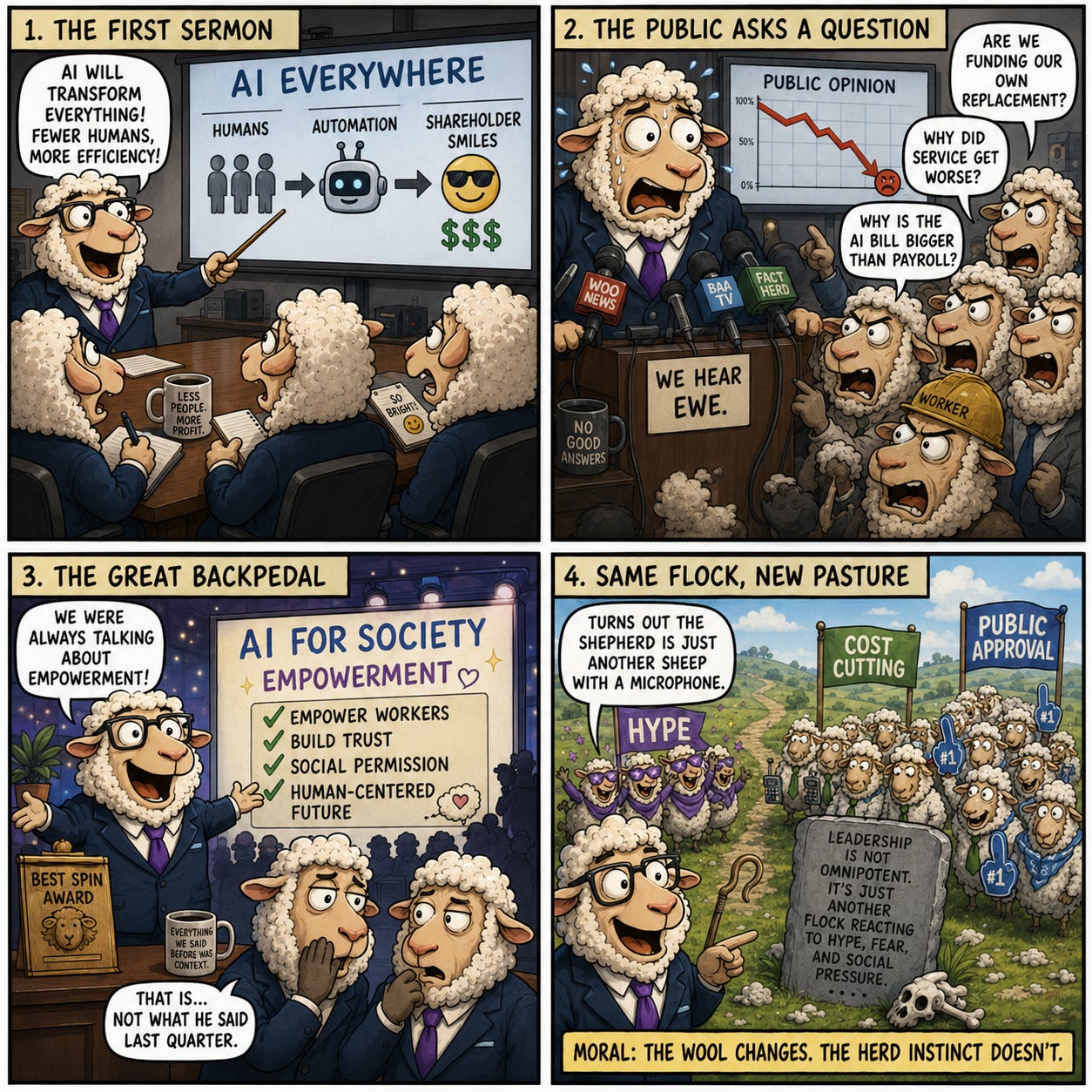
The Third Flock: The Great AI Backpedal
First came Token Maxxing: the belief that more AI usage meant more value.
Then came the uncomfortable discovery that replacing people with AI can sometimes cost more than the people.
Now comes the next phase: CEOs discovering that “society” has an opinion.
Not because society suddenly appeared. Workers, customers, communities, regulators, and the public were there the whole time. But during the first act of the AI boom, the pitch was cleaner: AI would automate work, reduce labor, increase productivity, and unlock a new economic era.
Then people started asking the obvious question:
Are we being asked to fund our own replacement?
That is where the messaging starts to shift. Suddenly the conversation becomes less about replacement and more about empowerment. Less about disruption and more about responsibility. Less about “AI will eat the world” and more about “AI needs social permission.”
Good.
Then prove it.
Because this is where leadership gets interesting. We often talk about executives as if they exist above the crowd, immune to fashion, fear, status, and public pressure. But the AI cycle is showing something much more human. Leadership is not omnipotent. It is subject to the same groupthink dynamics as everyone else.
The flock simply changes clothes.
One flock burns tokens because usage looks like progress. Another flock cuts headcount because savings look like strategy. Another flock pivots to social responsibility because public trust has become the new constraint.
That does not make AI fake. AI is real. AI is useful. AI will matter.
But it does expose the difference between strategy and synchronized migration.
The companies that win will not be the ones that chase every AI narrative as it rolls through the market. They will be the ones disciplined enough to ask harder questions:
What work actually improved?
What customer outcome changed?
What cost moved where?
What human judgment became more valuable, not less?
What are we measuring besides adoption theater?
Because you cannot sell replacement as revolution forever.
At some point, the people being replaced ask who the revolution is for. The customers ask why the product got worse. The board asks why the AI bill looks like payroll with a worse interface. And society asks why a handful of companies get to call enclosure “innovation.”
The sheep come in many flocks.
Some chase hype. Some chase savings. Some chase public approval.
The wool changes.
The behavior rarely does.
-Token Maxing: Pre AI generation managers trying to figure out what is their place in the world. The clear answer is that there. is 'None'
-Does AI cost more than people replacing it - With Token maxing - yes, AI costs more. Without that the answer is clear 'No' (at least in my opinion). Most jobs are not creative enough or research oriented to be more than minimal cognitive load. AI has no union and no minimal living standard, cost is entirely hardware depreciation and energy- which are always of decreasing cost path in the longer term (when we are past current shortages).
-People are not replacing themselves - the well off part of current generation is getting rich at the expense of the next generation. Latter have no say in this till legislators wake up- that would be a while. That societal structure will remain frozen for long- not unlike Standard Oil days
-Empowerment is a good conversation - but it is not real till it gets legislative teeth.
-Companies that will win are the ones who know AI more than just making LLM calls to the trained models. LLM calls are commodities - margins will be too thin aside from companies playing the brand name lock-in. Cursor got bought for $60B - that is SpaceX madness. But, when Claude CLI came last year, everyone stopped talking about Cursor immediately- it was just such a thin value over Anthropic.
:-)