


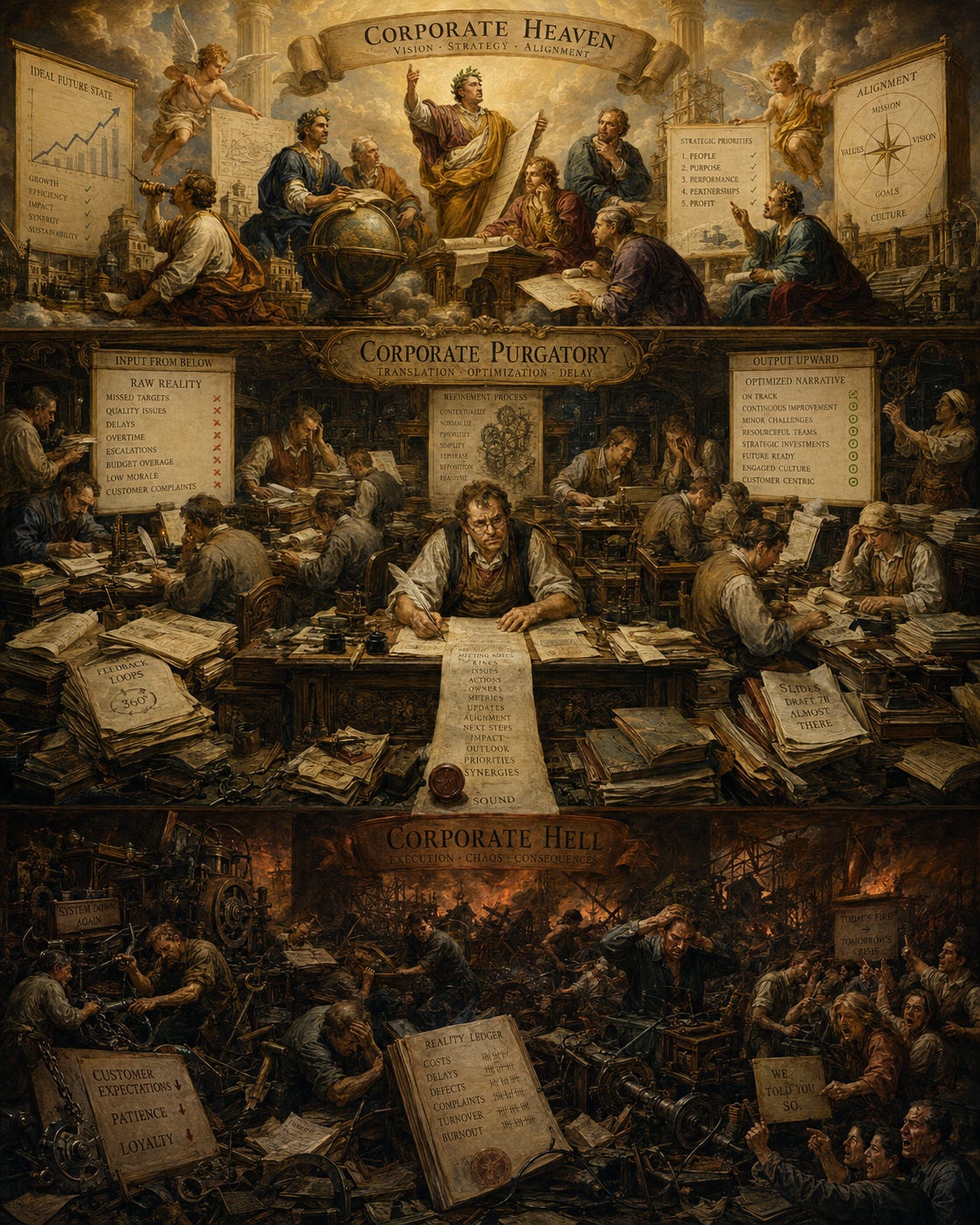
There is Heaven.
There is Hell.
And between them sits Purgatory, where an enormous amount of highly professional work is performed to make sure nobody has to decide which one we are actually in.
Heaven: Where Strategy Lives
Heaven is where the strategy is clear.
The positioning is differentiated.
The portfolio is integrated.
The organization is aligned.
The customer is at the center.
The market opportunity is enormous.
Every initiative has an owner, every dependency has an arrow, and every transformation has a three-year horizon conveniently beyond the current measurement period.
Heaven is clean because Heaven operates primarily in nouns:
Strategy.
Innovation.
Leadership.
Transformation.
Growth.
Nothing is late in Heaven.
It is sequenced. Nothing is missing.
It is on the roadmap. Nothing has failed.
It simply has not yet achieved its intended scale.
Heaven is a wonderful place.
Very little has to actually work there.
Hell: Where Reality Lives
Hell is where the verbs happen.
Build.
Integrate.
Sell.
Support.
Deliver.
Fix.
Explain.
This is where engineering discovers that the architecture cannot quite support the strategy.
Sales discovers that customers did not read the strategy.
Marketing discovers that competitors have also declared themselves differentiated.
Finance discovers that transformation requires money.
Operations discovers that the elegant new process requires eleven manual exceptions.
Support discovers that the seamless customer journey crosses four portals, three identity systems, six product teams, and a knowledge-base article written during the previous organizational structure.
Hell is full of unpleasantly specific words:
Delay.
Defect.
Escalation.
Churn.
Budget.
Headcount.
Outage.
These words cannot be allowed to ascend unaccompanied.
That is why we have Purgatory.
Purgatory: Where Judgment Is Deferred
Purgatory is mostly populated by middle managers.
Their job is often described as execution.
This is incomplete.
Their deeper responsibility is to maintain enough distance between strategy and reality that the organization has time to determine whether either one is correct.
Every morning they descend into Hell and collect facts.
The integration is six months late.
The customer is unhappy.
The feature does not work at scale.
The funding disappeared.
Two organizations believe the other owns the problem.
The original KPI has become inconvenient.
Then the purification begins.
“The integration is six months late” becomes:
Delivery sequencing has been adjusted to support quality.
“The customer is unhappy” becomes:
Customer feedback is helping refine the experience.
“The feature does not work at scale” becomes:
Additional validation is underway for broader deployment.
“The funding disappeared” becomes:
Investment priorities are being reassessed.
“Nobody owns this” becomes:
Cross-functional ownership is being clarified.
“The KPI went backward” becomes:
Early indicators have identified opportunities for optimization.
By afternoon, reality has been transformed into feedback.
By evening, feedback has become a presentation.
And by the next morning, the presentation has ascended into Heaven.
The Miracle of Organizational Translation
The customer says:
“This does not work.”
The account team hears:
“There is a capability gap.”
The manager reports:
“We have identified an opportunity to improve maturity.”
The director reports:
“Customer engagement is producing valuable learnings.”
The vice president reports:
“Market feedback is sharpening the value proposition.”
The executive slide reads:
“Strong customer engagement continues to validate the strategic direction.”
A failure signal entered the organization.
A strategy affirmation came out.
Nobody necessarily lied.
That is what makes the system interesting.
Each layer simply made the truth slightly more useful to the layer above it.
And Sometimes Purgatory Is Necessary
Here is the uncomfortable part.
Purgatory is not inherently bad.
Sometimes the strategy is right and execution genuinely needs more time.
Sometimes the product is early.
Sometimes the customer is wrong.
Sometimes engineering solves the problem.
Sometimes an ugly first release becomes a great business.
Immediate judgment would kill things that deserve to live.
Organizations therefore need a mechanism that absorbs temporary contradiction.
Purgatory provides it.
It buys time.
The problem begins when buying time becomes the objective rather than resolving the contradiction.
Three months becomes another quarter.
The pilot becomes an extended pilot.
The exception becomes a phased approach.
The missed target becomes a revised baseline.
The revised baseline becomes the new operating plan.
Eventually nobody remembers what the original promise was.
The organization has not succeeded.
It has not failed.
It has achieved something far more durable:
continued status.
The Sacred Colors
Purgatory has its own liturgical system.
Red means something has happened.
Yellow means we are discussing what happened.
Green means the discussion has produced an action plan.
Nothing about the underlying situation necessarily changed.
Only its administrative state.
A red KPI becomes yellow after a recovery plan is created.
The recovery plan becomes green when somebody is assigned to it.
The problem now has an owner.
Therefore, apparently, the problem is improving.
If necessary, explanatory material is moved into the appendix.
If the appendix becomes uncomfortable, it becomes backup.
If backup becomes uncomfortable, it becomes “available upon request.”
The executive dashboard returns to green.
Balance is restored.
The Middle Manager’s Actual Job
This is the peculiar burden of middle management.
They are close enough to Hell to know what is happening.
They are close enough to Heaven to know what is supposed to be happening.
And every week they are expected to produce a coherent narrative explaining why the distance between the two remains manageable.
Too much reality and they are accused of lacking strategic perspective.
Too much strategy and their teams stop believing them.
So the skilled middle manager learns to occupy the narrow space between candor and continuity.
Not:
“We failed.”
But:
“We are learning.”
Not:
“The strategy is wrong.”
But:
“The strategy is evolving.”
Not:
“We cannot deliver this.”
But:
“We are evaluating the path to scale.”
Not:
“The market doesn’t want it.”
But:
“Adoption is developing differently than anticipated.”
These sentences have enormous corporate value.
They create time.
And time is sometimes precisely what an organization needs.
The question is what happens next.
Because Eventually Someone Has to Die
Not literally.
Products.
Strategies.
Projects.
Assumptions.
Operating models.
Sometimes entire PowerPoint templates.
Eventually reality has to resolve the argument.
Either execution catches up with strategy—
and Purgatory becomes the bridge that protected a good idea long enough to succeed.
Or it does not—
and Purgatory becomes the machinery that kept a bad idea alive long enough to become expensive.
That is the tension.
The same management system that gives innovation room to mature can also give failure room to hide.
The difference is whether each trip through Purgatory reduces the distance between Heaven and Hell.
If the product improves, the gap should shrink.
If the customer problem is being solved, the complaints should decline.
If the strategy is sound, reality should gradually begin to resemble the deck.
If none of those things happen, then another presentation is not progress.
It is an extension.
The Corporate Trinity
And so the corporation remains in balance.
Heaven declares what should be true.
Hell reports what is true.
Purgatory explains why the difference remains acceptable for another quarter.
Sometimes that buys enough time for success.
Sometimes it merely postpones failure.
And that may be the most important question buried beneath every beautifully presented executive update:
Are we buying time to fix reality — or buying time before reality catches us?