


Take 3 as the key
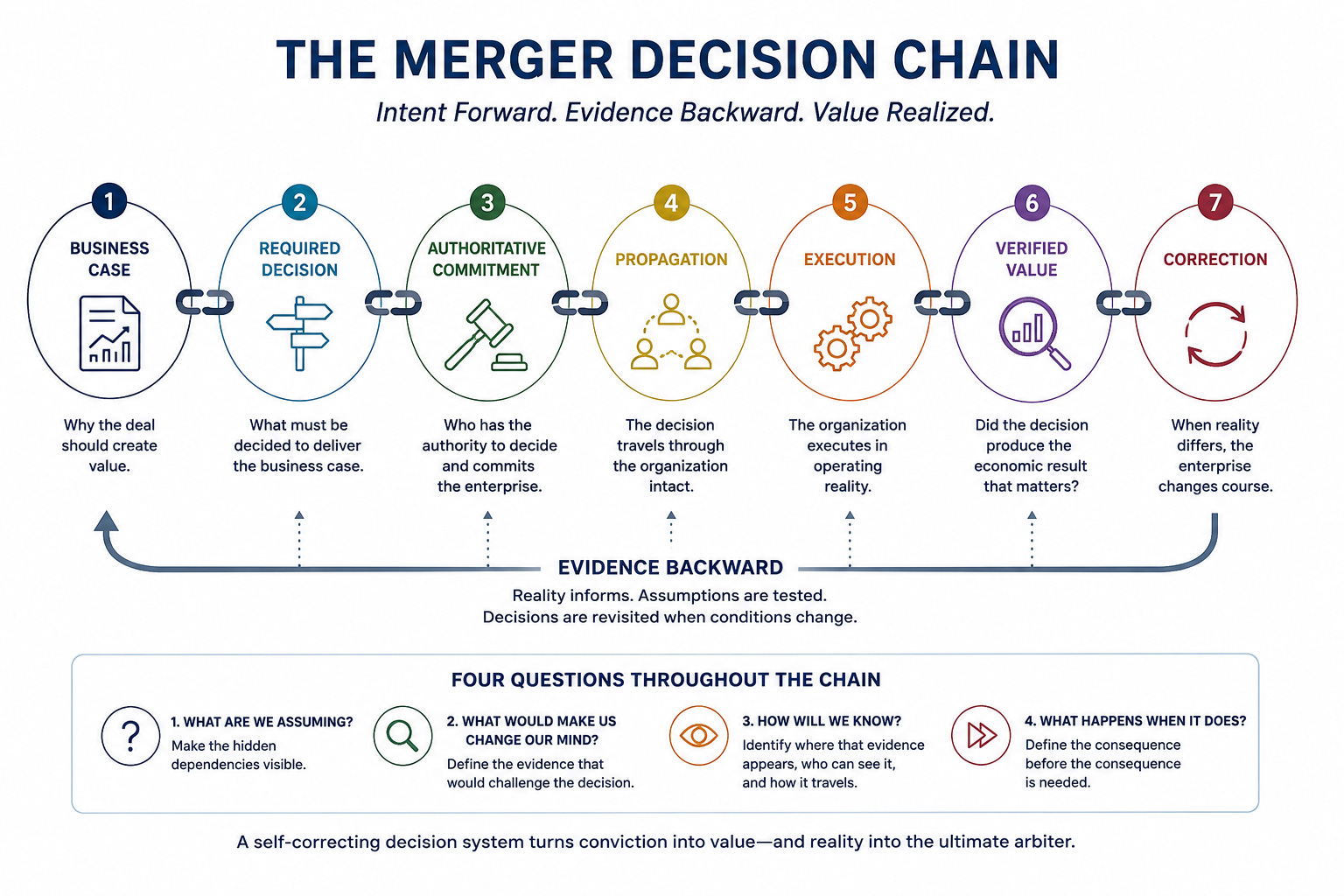
Merger value depends on a chain: Business Case → Required Decision → Authoritative Commitment → Propagation → Execution → Verified Value → Correction.
A functioning chain is not enough. An enterprise can become extraordinarily efficient at executing a decision that is no longer valid. Every link therefore needs a second question: What would make us change our mind?
This is a toolkit, not a maturity model to impose whole cloth. Start at the weakest link the organization can realistically improve. Add controls as maturity permits.
In an earlier piece, I proposed a simple question for testing merger execution:
Can the combined enterprise make, propagate, and execute the decisions required to deliver the business case for which the merger was approved?
From that came the decision chain:
Business Case → Required Decision → Authoritative Commitment → Propagation → Execution → Verified Value → Correction
The premise was that a merger does not create value because the transaction closes.
It creates value only when the combined enterprise can convert the original economic thesis into decisions, turn those decisions into authoritative commitments, propagate them through the organization without losing meaning, execute them in operating reality, verify the resulting value, and correct course when reality diverges from expectation.
Then Meir Amarin made an important observation in response:
“What would make us change our mind?”
He followed it with the reason:
Without that question, even a beautifully designed decision chain can become an efficient machine for executing the wrong decision.
That is the right challenge.
And it expands the model.
The Problem Isn’t Only Whether the Chain Works
Consider a classic merger success case.
Company A acquires Company B because management believes the combined company can create value through:
cross-selling;
elimination of duplicated costs;
increased purchasing leverage;
consolidation of infrastructure;
expanded market access;
and improved customer economics.
Those are the Business Case.
But they are not yet operating reality.
For the cross-selling thesis alone, somebody may have to decide:
which sales organization owns which customers;
whether salesforces remain separate or combine;
which products each team can sell;
how compensation works;
which CRM becomes authoritative;
how account conflicts are resolved;
and which products receive investment priority.
Those are Required Decisions.
Someone must have authority to make them.
That becomes Authoritative Commitment.
Those decisions then have to reach Sales, Finance, IT, Product, Legal, Operations and regional management with their meaning intact.
That is Propagation.
Compensation plans change. CRM permissions change. Account ownership changes. Products become available to different sales teams. Budgets move.
That is Execution.
Then comes the question integration dashboards too often treat as an afterthought:
Did cross-sell revenue actually materialize?
At what margin?
Against what baseline?
At what cost?
That is Verified Value.
And when the economics differ from the business case, another decision becomes necessary.
That is Correction.
The chain works.
Except there is another possibility.
What if everyone executed perfectly—
and the original decision was wrong?
Enter the Second Dimension
The original chain primarily tests decision integrity.
Can intent survive the journey from the boardroom into operating reality?
Meir’s question introduces another requirement:
decision validity.
Does the decision still deserve to survive?
Those are different problems.
A decision can be:
poorly executed but correct,
or
perfectly executed but wrong.
The second may be more dangerous because good execution can conceal bad reasoning for longer.
This is not merely theoretical.
Barry Staw’s foundational research on escalation of commitment demonstrated a counterintuitive behavior: negative results do not necessarily cause decision-makers to retreat from a previous decision. Under some conditions, particularly where they feel personally responsible for the original choice, they may commit still more resources to it. (ScienceDirect)
That matters enormously in M&A.
By the time a merger reaches execution, people are invested.
Capital has been committed.
Executives have defended the transaction.
Synergy numbers have been presented.
Teams have been reorganized.
Technology choices have been made.
Careers may now be attached to particular integration decisions.
The organization can gradually stop asking:
Is this still the right decision?
and begin asking:
How do we make this decision work?
Those questions sound similar.
They are not.
Every Decision Needs Two Tests
I would now put two questions against every material link in the chain.
The Validity Test
What would make us change our mind?
What evidence, assumption failure, customer behavior, market movement, operating result or economic variance would cause us to reconsider the decision?
Then comes the second question.
The Consequence Test
If that condition occurs, what happens next?
Who reopens the decision?
What pauses?
What continues?
Who has authority?
What gets escalated?
What value becomes exposed?
This is where my earlier “Or What?” framing fits more precisely.
It is not a threat.
It is not escalation for escalation’s sake.
It is a test of whether discovering that something has changed actually has a consequence.
Put the two together:
What would change our mind? → How will we know? → What happens when it does?
Now we have a closed loop.
Run That Test Through the Chain
1. Business Case — What Are We Assuming?
The business case says why the deal should create value.
But every business case contains assumptions.
Customers will cross-buy.
Costs can be removed.
Systems can be consolidated.
Talent will remain.
Market conditions will persist.
Integration can happen within a certain period.
McKinsey has long warned that merger synergy estimates can be distorted by optimistic assumptions, including assumptions around revenue, timing and dis-synergies. Its more recent M&A work similarly argues that synergy cases should become increasingly evidence-based and should be revisited after acquisition as better information becomes available. (McKinsey & Company)
So attach a question to the business case:
What would have to become untrue for this element of the deal thesis no longer to hold?
Now the business case becomes more than a forecast.
It becomes a set of testable propositions.
2. Required Decision — What Evidence Would Change the Choice?
Suppose management decides to preserve two sales organizations while enabling cross-selling.
Fine.
Now ask:
What evidence would make us conclude that this is no longer the right operating model?
Account conflict?
Customer confusion?
Weak conversion?
Margin leakage?
Compensation disputes?
Salesforce resistance?
The point is not to undermine the decision.
The point is to define the conditions under which the decision should be challenged before those conditions appear.
This creates something valuable:
a decision with a defined change condition.
3. Authoritative Commitment — Binding Does Not Mean Permanent
A merger needs authoritative decisions.
Endless consensus seeking destroys velocity.
But there is an important distinction:
A decision must be binding enough to execute without becoming immune to evidence.
That means recording more than:
What did we decide?
Record:
who decided;
why;
what evidence supported the decision;
which assumptions were material;
what result was expected;
and what conditions justify reopening it.
This is particularly important given what escalation-of-commitment research tells us.
The person most invested in making the original decision may not always be the ideal mechanism for determining whether it remains valid. (ScienceDirect)
Authority should create commitment.
It should not eliminate falsifiability.
4. Propagation — Decisions Go Down. Evidence Must Come Back.
This may be the most important expansion to the original chain.
We tend to think of propagation as one-way:
Leadership → Organization
The decision moves downward.
But a self-correcting enterprise needs another path:
Operating Reality → Leadership
Evidence must move backward.
Customer resistance.
Unexpected technology limitations.
Employee behavior.
Local market conditions.
Margin deterioration.
Operational friction.
These signals often appear first at the edge of the enterprise, far from the executives who made the decision.
So the propagation question becomes:
Can contradictory evidence travel upstream with the same integrity that authority travels downstream?
If not, the system has a serious design flaw.
It can distribute a decision everywhere while filtering out the evidence capable of disproving it.
That is how a strong chain becomes an amplifier for a weak decision.
5. Execution — Implementation Is Also an Experiment
Execution changes operating reality.
It also creates information that did not exist when the original decision was made.
That makes execution more than implementation.
It is a test.
Gary Klein’s premortem is useful here. Rather than waiting for a project to fail and conducting a postmortem, participants assume in advance that the effort has failed and identify plausible reasons why. One purpose is to create room for concerns and dissent before commitment becomes difficult to challenge. (Harvard Business Review)
Applied to a merger decision:
Imagine this decision has been fully implemented and produced the opposite of what we expected. Why?
The strongest answers become things to watch.
Now execution is instrumented.
The question changes from:
Did we implement the decision?
to:
What is implementation teaching us about whether the decision should continue?
6. Verified Value — Give Reality a Vote
This is where the model becomes difficult to game.
A workstream can be green.
A milestone can be complete.
A system can be migrated.
A reorganization can be finished.
And the merger can still be destroying value.
Verified Value therefore asks:
Did the operating change produce the economic result that justified the decision?
McKinsey’s integration research makes a similar distinction between identifying theoretical sources of value and translating them into granular baselines, targets, milestone-driven plans and measurable outcomes. It has also observed that stronger acquirers formally revisit value creation during integration rather than treating the original synergy expectation as fixed. (McKinsey & Company)
This is where reality gets a vote.
Not the integration dashboard.
Not the original presentation.
Not executive conviction.
Reality.
7. Correction — Give Reality Consequence
This is the final refinement.
Correction should not be where doubt first appears.
It should be where previously defined doubt becomes consequential.
By this point the organization should already know:
which assumption failed;
what evidence demonstrated it;
which decision is affected;
which threshold was crossed;
who has authority to reconsider the decision;
what can continue;
what must stop;
and what portion of the business case is now exposed.
So Correction is no longer:
Something went wrong. What do we do?
It becomes:
The condition we said would cause reconsideration has occurred. What decision follows?
That is materially different.
It is controlled adaptation.
Intent Forward. Evidence Backward.
This changes how I now visualize the decision chain.
The original model carries force forward:
Business Case → Required Decision → Authoritative Commitment → Propagation → Execution → Verified Value → Correction
But the mature version has two flows.
Intent moves forward.
Business Case → Decision → Commitment → Execution.
Evidence moves backward.
Reality → Measurement → Challenge → Reconsideration.
The organization needs both.
Too little commitment and decisions never become operating reality.
Too little challenge and operating reality becomes captive to decisions that no longer deserve to survive.
The objective is therefore not maximum certainty.
Nor endless reconsideration.
It is:
controlled conviction.
Enough commitment to move.
Enough instrumentation to know when movement is wrong.
Enough authority to change direction.
The Four-Question Acid Test
For any material merger decision, I would now ask four questions:
1. What are we assuming?
Make the hidden dependency visible.
2. What would make us change our mind?
Define the evidence capable of challenging the decision.
3. How will we know?
Identify where that evidence appears, who can see it and how it travels.
4. What happens when it does?
Define the consequence before the consequence is needed.
This is where “Or What?” becomes useful.
Not as the opening question.
As the closing control.
It tests whether the organization has connected evidence to consequence.
But Don’t Install the Whole Machine
There is a temptation with frameworks like this to turn them into maturity theater.
Seven gates.
Four questions.
New governance forums.
New templates.
New reporting.
New committees.
And suddenly the mechanism intended to improve decision quality becomes another integration program to implement.
That misses the point.
Organizational maturity is always the constraint.
These ideas are better understood as tools in a kit, not an architecture that every company should be forced to adopt whole cloth.
One organization may need only one tool:
Who actually has authority to make this decision?
Another may already have strong authority but weak propagation.
Its question is:
Did the decision arrive intact?
Another may execute exceptionally well but suppress contradictory information.
Its intervention is:
What would make us change our mind—and how would that evidence reach us?
Another may have excellent measurement but no consequence attached to variance.
Its question becomes:
The threshold was crossed. Now what?
Different maturity.
Different weak link.
Different tool.
That is not a compromise in the model.
It is how the model becomes usable.
Start With the Weakest Link
The chain should tell us where to look.
The toolkit should tell us what to apply.
Maturity should tell us how much the organization can absorb.
That suggests a much more practical implementation path:
Find the material decision.
Find its weakest link.
Apply the smallest control that materially strengthens it.
Prove that the control works.
Then move to the next constraint.
Over time, those tools may become a coherent closed-loop decision architecture.
But they do not need to begin that way.
A company capable only of explicitly documenting assumptions should start there.
A company ready to define change conditions should do that.
A company capable of instrumenting evidence and tying it to predetermined correction can go further.
The objective is not framework compliance.
The objective is better enterprise behavior.
The Expanded Merger Question
So I would now expand my original question.
It began as:
Can the combined enterprise make, propagate and execute the decisions required to deliver the business case for which the merger was approved?
The chain added verification and correction.
Meir’s challenge adds something more fundamental:
Can the enterprise also recognize when one of those decisions no longer deserves to be executed?
And then comes the consequence test:
When that happens, does the enterprise already know what comes next?
That is the difference between an execution machine and a self-correcting decision system.
But it is not necessary to build the entire system on day one.
The chain is the model.
The questions and controls are the tools.
The weakest link tells us where to use them.
Organizational maturity determines how much of the architecture can become operating reality.
Start there.
Strengthen what the enterprise is capable of strengthening.
Then let demonstrated capability—not framework ambition—determine what gets built next.
A note on research:
The research underpinning the article is fairly consistent across behavioral decision-making and M&A practice: escalation of commitment explains why negative evidence may not automatically reverse a decision; premortems provide a practical way to surface disconfirming views before commitment deepens; and merger research supports repeatedly testing synergy assumptions against granular baselines and actual value capture rather than freezing the diligence case in place.
References
1. Amarin, Meir. “Arrogance vs. Conceit: Who Wins?” LinkedIn, 2026.
https://www.linkedin.com/pulse/arrogance-vs-conceit-who-wins-meir-amarin-qjvaf
2. Staw, Barry M. “Knee-Deep in the Big Muddy: A Study of Escalating Commitment to a Chosen Course of Action.” Organizational Behavior and Human Performance, 16(1), 1976, 27–44.
https://doi.org/10.1016/0030-5073(76)90005-2
3. Klein, Gary. “Performing a Project Premortem.” Harvard Business Review, September 2007.
https://hbr.org/2007/09/performing-a-project-premortem
4. Doherty, Rebecca; Engert, Oliver; West, Andy. “How the Best Acquirers Excel at Integration.” McKinsey & Company, 2016.
5. Engert, Oliver; Flötotto, Max; Gryzwa, Greg; Sachdeva, Milind; Strojny, Patryk. “Eight Basic Beliefs About Capturing Value in a Merger.” McKinsey & Company, 2019.
6. Christofferson, Scott A.; McNish, Robert S.; Sias, Diane L. “Where Mergers Go Wrong.” McKinsey Quarterly, 2004.