


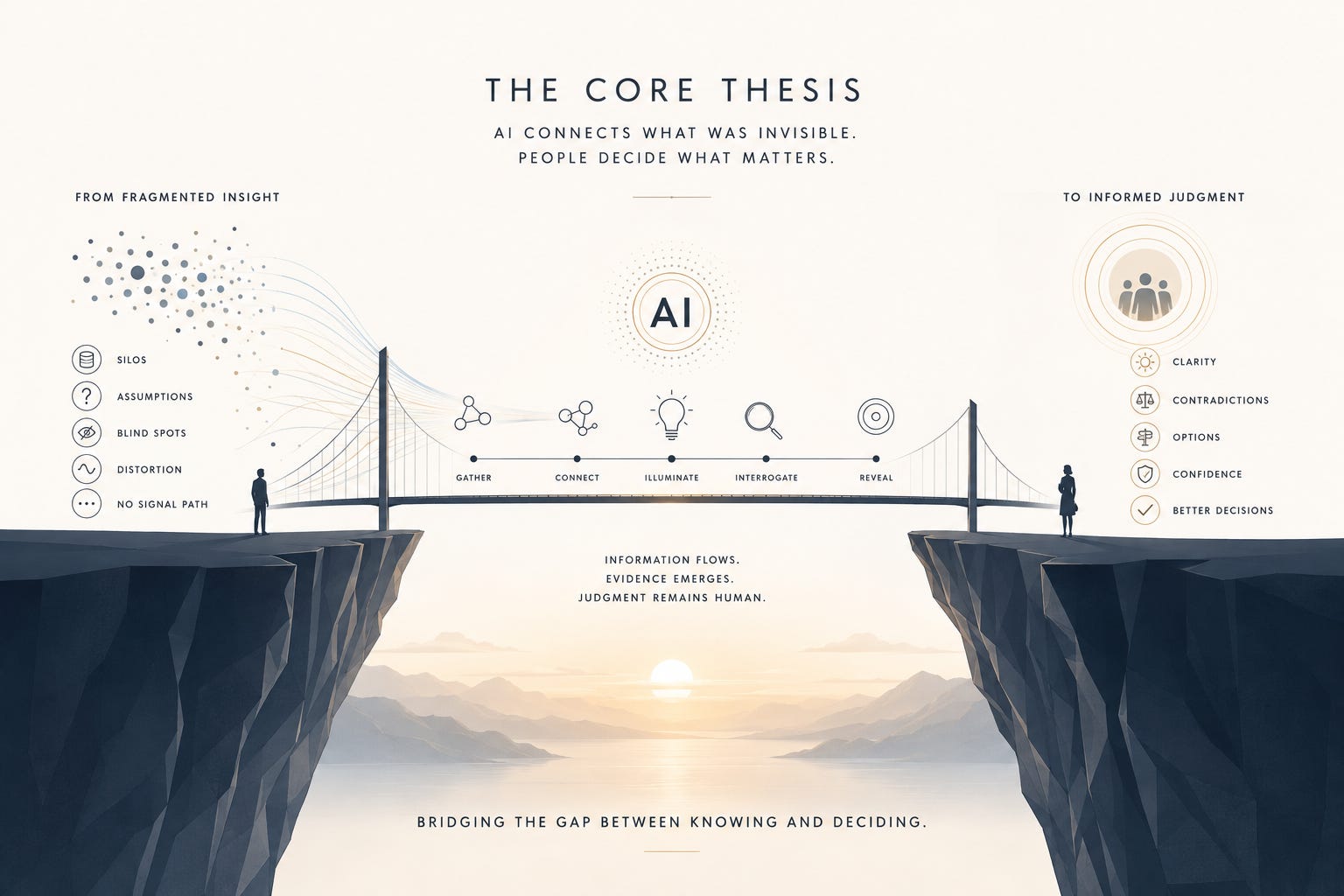
Most leaders believe AI will solve the age-old problem of human error. They’re wrong. AI doesn’t eliminate bounded rationality; it redistributes it. To survive the AI transition, organizations must stop chasing “faster answers” and start building a new cognitive architecture that balances machine fluency with human judgment.
It Creates a New Cognitive System — and Organizations Will Fail if They Confuse Machine Fluency with Human Judgment
The most consequential change AI brings to merger decisions is not faster analysis.
It is not cheaper diligence.
It is not better presentations.
It is not even automation.
It is that the cognitive architecture of the organization changes.
For decades, organizational decision-making has been constrained by a familiar problem: humans possess finite attention, finite working memory, incomplete information, uneven expertise, limited time, political incentives, and radically different views of the same operating reality.
That is bounded rationality.
AI does not abolish it; it redistributes it.
It redistributes it.
The human remains bounded.
The machine is bounded differently.
And the organization now has to manage the interaction between those two forms of limitation.
That is the real AI problem.
Why AI Won’t “Fix” Better Decisions
The Original Merger Problem Was Always Cognitive
A merger thesis is an attempt to compress an enormous future into a manageable decision.
Revenue synergies.
Cost synergies.
Customer retention.
Technology consolidation.
Cultural compatibility.
Operating-model alignment.
Regulatory assumptions.
Integration timing.
Talent retention.
Capital allocation.
Hundreds of uncertain variables become a few scenarios, a valuation range and ultimately a recommendation.
That compression is necessary.
No board can consciously process every operational dependency in two companies simultaneously.
Humans survive complexity by simplifying it.
Herbert Simon’s concept of bounded rationality described precisely this condition: decision-makers do not optimize across every possible alternative because they cannot. They operate within limitations of information, cognition and time and search for satisfactory solutions.
Contemporary research on human–AI decision-making is returning directly to Simon’s insight. A 2026 systematic review argues that AI produces a bounded–augmented rationality continuum.
That is a considerably more useful frame than “AI makes better decisions.”
It doesn’t.
It changes the system in which decisions are made.
The Danger of Lossy Compression
Humans Compress Reality Through Meaning
Human cognition is extraordinarily powerful precisely because it does not process everything.
We recognize patterns.
We create abstractions.
We infer intent.
We notice anomalies.
We construct causal explanations.
We draw upon experience.
We integrate emotion, consequence, social relationships, physical experience and context.
And we discard enormous amounts of information.
That last part matters.
Human cognition is selective by necessity.
What reaches conscious attention has already survived layers of filtering.
Inside a merger, those filters compound.
An engineer notices an architecture dependency.
A director converts it into a project risk.
A vice president converts the risk into a timeline issue.
An integration committee converts the timeline issue into a yellow status indicator.
The board sees:
Integration: On Track With Manageable Risk.
Nobody necessarily lied.
The organization compressed.
Compression is lossy. Organizations often mistake the compressed representation for the underlying reality.
And organizations often mistake the compressed representation for the underlying reality.
Machines Compress Reality Differently
Modern AI systems have a radically different cognitive profile.
They can examine volumes of information humans cannot practically hold simultaneously.
They can rapidly search across thousands of documents.
They can compare representations.
They can identify patterns.
They can generate hypotheses.
They can translate between technical and executive language.
They can repeatedly reframe a problem without fatigue.
They can explore large numbers of candidate interpretations cheaply.
But none of this means they experience the world as humans do.
Recent organizational research makes that distinction explicit. Stein and Shollo argue that contemporary discussions of human–AI collaboration often reduce human cognition to information processing and thereby overlook fundamental differences involving embodiment and emotion. Their argument is that machine cognition remains fundamentally computational, whereas human cognition involves lived, embodied and affective experience.
That distinction matters in a merger.
The machine can read every employee survey.
It does not experience fear of losing a job.
It can analyze customer complaints.
It has never watched a customer terminate a relationship after ten years.
It can model system outages.
It has never stood inside an operations center while production collapses.
It can process the language of organizational culture.
It does not inhabit that culture.
This is not mystical human exceptionalism.
It is a boundary condition.
Representation is not experience.
The Skill Shift: From Prompting to Calibration
Which Means the Human–Machine System Is the Unit That Matters
The useful question is therefore not:
Who is smarter — the human or the AI?
That question is increasingly meaningless.
The relevant question is:
What cognitive work should each component of the system perform?
Research on human–AI complementarity increasingly points in this direction.
Gonzalez and Heidari argue that humans and AI have different advantages: AI performs extremely well at large-scale data processing, pattern identification and optimization, while humans retain particular strengths in uncertainty, novelty and interpersonal environments.
And the evidence does not support the simplistic claim that adding AI automatically improves human performance.
A major Nature Human Behaviour meta-analysis examined human–AI combinations across experimental studies and found that human–AI systems do not consistently outperform the better of humans or AI working alone. Whether complementarity emerges depends heavily on task structure and relative capabilities.
That finding should kill one of the industry’s favorite assumptions:
Human + AI > Human.
Sometimes.
Not automatically.
The architecture matters.
The Productivity Trap: When Effort is Education
The Central Cognitive Problem Becomes Calibration
Consider an employee examining an AI-generated analysis.
Three possibilities exist.
The AI is correct.
The employee is correct.
Neither is correct.
The challenge is determining which condition applies.
That requires something humans have always struggled with:
metacognition.
Metacognition is our ability to evaluate our own thinking.
What do I know?
What don’t I know?
How confident should I be?
When should I seek help?
Which external source should I trust?
Andy Clark argues that this capability becomes increasingly important in an AI-mediated world. Humans have always extended cognition through external tools — notebooks, maps, calculators, other people and institutions. Generative AI is another extension, but one that requires much more sophisticated judgments about when and how to rely upon it.
This is the real skill shift.
Prompt engineering is temporary.
Prompt engineering is temporary. Calibration is permanent.
The valuable employee will increasingly be the person who can determine:
I should delegate this.
I should verify this.
I should challenge this.
I do not understand this sufficiently to judge it.
The model probably knows more than I do here.
The model almost certainly lacks critical context here.
That is metacognitive competence.
And organizations currently have almost no formal systems for teaching it.
AI Can Lower Cognitive Load — and That Is Both the Benefit and the Threat
One of AI’s most obvious advantages is cognitive offloading.
We have always externalized cognitive work.
Writing prevents us from having to remember everything.
Spreadsheets externalize arithmetic.
Calendars externalize prospective memory.
GPS externalizes navigation.
Search externalizes recall.
AI extends this much further.
It can externalize synthesis.
Comparison.
Drafting.
Classification.
Programming.
Research.
Planning.
Even portions of reasoning.
That can be tremendously valuable.
Cognitive-offloading research has long shown that external resources can free limited mental capacity for other tasks. A 2025 Nature Reviews Psychology review describes both the benefits and potential costs of transferring memory-related work into external systems.
But there is a trap.
Effort is not always waste. Sometimes friction is how humans learn.
Sometimes effort is how humans learn.
Sometimes friction is how humans discover that they do not understand something.
Sometimes struggling with evidence is what creates the mental model required to recognize an error later.
AI can remove useful cognitive friction along with useless cognitive friction.
A 2025 randomized controlled trial involving 120 students found that participants using ChatGPT during learning performed worse on a surprise retention test 45 days later than participants using traditional study methods: 57.5% versus 68.5% correct. The authors interpret the result as consistent with reduced effortful processing and cognitive offloading.
That single study should not be generalized into “AI makes people stupid.”
But it illustrates the mechanism organizations should care about.
Performance today and capability tomorrow are not the same variable.
Nature Reviews Psychology makes precisely that distinction: generative AI can improve immediate task performance without necessarily producing the deeper cognitive and metacognitive processing required for durable learning.
That is enormously important in merger integration.
An organization can use AI to get through the integration faster while simultaneously making its people less capable of understanding the integrated system.
That would look like productivity.
Until something breaks.
There Is Already Evidence of an Offloading Threshold
More recent experimental work makes the trade-off even sharper.
A 2026 controlled experiment involving 130 participants compared different levels of AI cognitive offloading. Direct AI recommendations produced the highest immediate decision accuracy and fastest responses. But those users developed less skill than participants receiving more analytical or evaluative forms of AI assistance. Moderate and lower offloading supported greater skill development. The researchers linked the effect to metacognitive miscalibration — people becoming less accurate in judging their own competence.
That is exactly the organizational danger.
Imagine an integration team that has become extremely productive with AI.
They produce analyses faster.
Their documents improve.
Their recommendations become more polished.
Their meetings become more efficient.
And their internal understanding of the system quietly deteriorates.
They appear increasingly competent.
They may even feel increasingly competent.
Until the machine fails.
Or the situation moves outside the distribution of previous experience.
Or local context contradicts the model.
Then the organization discovers that it automated not merely work.
It automated competence formation.
Bias Recursion: When Loops Close Tight
This Is Why Automation Bias Matters
Humans do not evaluate machine recommendations neutrally.
We anchor on them.
We defer to them.
We search for confirmation.
We interpret fluency as competence.
And the more reliable automation becomes, the easier it becomes to stop checking.
A 2025 systematic review examining 35 peer-reviewed studies identified automation bias as a major challenge in human–AI collaboration. Importantly, the authors found that explainability alone does not reliably solve the problem. Explanations can themselves increase cognitive load or create misplaced trust. User engagement and independent verification remain critical.
The review also describes interactions between automation bias and familiar human biases such as anchoring and confirmation bias.
This produces a fascinating feedback loop.
Humans built machines partly because humans are biased.
Then humans become biased toward the machine.
The machine itself reflects biases introduced through data, objective functions, model architecture and training.
Then human confirmation bias can reinforce machine output.
The result is not bias elimination.
The result is not bias elimination. It can become bias recursion.
Fluency Makes This Worse
Generative AI has a characteristic older decision-support systems did not possess at anything like the same level:
It communicates beautifully.
That matters cognitively.
Humans use fluency as a heuristic.
An argument that is coherent, confident, well-structured and immediately understandable feels more credible.
But linguistic fluency and epistemic reliability are different properties.
Modern research on critical thinking in generative-AI use identifies this as a central mechanism of overreliance: fluent, plausible outputs can reduce the user’s perceived need for scrutiny.
This creates a new organizational risk.
Previously, weak analysis often looked weak.
AI can make weak analysis look excellent.
A beautifully structured merger memo can still contain a catastrophic assumption.
The typography has improved.
The epistemology has not.
The Strategic Competitive Advantage
The Countermeasure Is Cognitive Friction
Most AI product design optimizes toward fewer steps.
Faster answer.
Less effort.
More automation.
From a productivity perspective, that makes sense.
From a cognitive perspective, it can be exactly wrong.
Recent scholarship on AI-supported critical thinking increasingly argues for preserving deliberate cognitive friction: requiring users to interpret, evaluate, challenge and justify AI-generated outputs rather than merely consume them.
That gives us a radically different principle for enterprise AI:
Do not automate every point at which a human currently thinks.
Automate the portions where thinking adds little value.
Intensify human engagement where judgment matters.
For merger decisions that might mean:
AI performs exhaustive document comparison.
Humans interpret strategic significance.
AI surfaces contradictory evidence.
Humans determine whether the contradiction changes the thesis.
AI generates alternative causal explanations.
Humans decide which explanations deserve investigation.
AI models scenarios.
Humans determine what outcomes are tolerable.
AI monitors emerging evidence.
Humans remain accountable for changing course.
The objective is not minimal cognition.
It is optimal cognition.
Distributed Cognition Changes the Organizational Model
Cognitive science offers another useful idea here.
Thinking does not occur entirely inside an individual’s skull.
Cognition can be distributed across people, artifacts, representations, procedures and technologies.
Organizations already function this way.
Nobody “knows” an entire corporation.
The corporation knows through:
people,
documents,
databases,
software,
rituals,
organizational memory,
communication channels,
and coordination structures.
Generative AI becomes another participant in that distributed cognitive system.
A 2026 Journal of Documentation paper models human–AI interaction explicitly through distributed cognition. Rather than treating the user and AI as independent intelligences, it describes a coupled cognitive cycle involving intention formation, external representation, machine generation, human evaluation and cognitive updating. Whether AI produces cognitive enhancement or cognitive atrophy depends partly on whether that cycle actually completes.
That last point matters enormously.
If AI generates the answer and the human merely acts on it, the cognitive loop is incomplete.
If AI generates an answer, the human evaluates it, updates their mental model, challenges the system and feeds new context back into it, cognition is being distributed rather than merely displaced.
That is a fundamentally different architecture.
Now Return to the Engineer at the Bottom of the Trench
The engineer sees that the integration schedule is impossible.
Previously, the organization depended on communication hierarchy to move that cognition upward.
That hierarchy distorted information.
AI can alter the pathway.
The engineer’s observation can be connected to:
dependency graphs,
incident histories,
migration estimates,
architecture decisions,
vendor contracts,
staffing constraints,
security requirements,
and previous integration assumptions.
AI can construct the evidentiary surface.
But there is something the machine cannot automatically supply:
organizational courage.
Someone still has to accept the possibility that the engineer is right.
Someone has to tolerate the disruption caused by new evidence.
Someone has to distinguish legitimate contradiction from resistance.
Someone may have to admit that the original model was wrong.
AI can reduce epistemic friction.
It cannot eliminate political friction.
And in many organizations, political friction was the real constraint all along.
Which Exposes the Deeper Problem With Merger Decisions
Most organizations act as though a decision ends when it is approved.
Cognitively, that is backward.
Approval should begin a continuous process of hypothesis testing.
The merger thesis should be treated as a model.
A model contains assumptions.
Assumptions generate predictions.
Reality produces observations.
Observations should update the model.
That is not indecision.
That is learning.
The human problem is that belief updating is psychologically expensive.
We become attached to previous judgments.
We defend sunk costs.
We protect identity.
We preserve status.
We seek confirming evidence.
We reinterpret contradictory evidence.
AI can help search the evidence space.
But if deployed badly, it can just as easily become a machine for industrializing confirmation bias.
Ask:
Why was this merger a good decision?
and the system will generate arguments.
Ask:
Why was this merger a catastrophic mistake?
and the system will generate those too.
The intelligence lies not in generating either narrative.
It lies in designing the inquiry.
This Is Where Human and Machine Paradigms Diverge Most Sharply
The machine paradigm is fundamentally computational.
It seeks representations that support prediction, generation, classification and optimization.
The human paradigm is simultaneously computational, embodied, emotional, social and normative.
Humans care what happens.
Humans experience consequences.
Humans construct identity.
Humans assign meaning.
Humans decide which outcomes are worth pursuing.
That is why simply making AI increasingly human-like may be the wrong goal.
A 2026 Nature Reviews Psychology commentary argues that human–AI complementarity should emphasize augmentation rather than emulation: machines need not reproduce human cognition to be useful partners; their value can arise precisely from cognitive difference.
That idea deserves much more attention.
We don’t need machines that think exactly like us.
We already have eight billion systems capable of that general architecture.
We need systems that expose what human cognition systematically misses.
And humans capable of exposing what machine cognition systematically misses.
The Competitive Advantage Is Therefore Not AI Adoption
Almost everyone will have powerful models.
Model capabilities will diffuse.
Inference costs will fall.
Agentic systems will improve.
Enterprise software will absorb the functionality.
The differentiator will increasingly be the architecture of cognition around the model.
A 2026 Business Horizons analysis makes the organizational implication explicit: companies seeking human–AI synergy will need to redesign roles, workflows and learning systems rather than treating AI merely as an automation mechanism.
Another 2026 systematic review of hybrid intelligence identifies automation bias, algorithm aversion, confirmation-bias amplification and expertise paradoxes as central unresolved problems in human–AI organizational systems.
This means the question for leadership is no longer:
Do our people use AI?
That will become trivial.
The questions are harder:
Who decides when AI should be trusted?
Who is responsible for checking it?
Which cognitive tasks may safely be offloaded?
Which cognitive capabilities must remain practiced?
How do employees learn where the model fails?
How does contradictory evidence travel upward?
How is confidence calibrated?
How are human and machine disagreement resolved?
Who owns the final judgment?
And most importantly:
Does the organization become smarter as its AI becomes smarter?
Those are not the same thing.
The Merger Decision Becomes a Cognitive System
The original merger thesis can now be reconstructed.
The board does not make the decision alone.
The model does not make it.
The operating team does not make it.
The frontline employee does not make it.
The AI does not make it.
The effective decision emerges from a system of distributed cognition.
Each component sees something.
Each component misses something.
The quality of the outcome depends on whether the organization can preserve those differences while allowing information to move between them.
This is why confidence calibration matters. Recent research demonstrates that human judgments can improve machine-only decisions when humans and machines make different errors and their confidence is meaningfully calibrated.
Difference is not inefficiency.
Difference is the source of complementarity.
AI Therefore Changes the Fundamental Constraint
Before AI, the organization struggled because cognition was expensive.
It could not read everything.
Compare everything.
Remember everything.
Simulate everything.
Interrogate every assumption.
AI progressively reduces those constraints.
But the cognitive sciences tell us what comes next.
The new constraints become:
attention,
verification,
metacognition,
calibration,
epistemic discipline,
incentives,
psychological safety,
organizational learning,
and willingness to revise beliefs.
In other words:
AI removes some computational constraints and exposes the human ones underneath them.
That is the shift.
And That Leads to a Harder Conclusion
For years organizations could plausibly say:
We didn’t know.
The information wasn’t available.
There was too much data.
We didn’t have enough analysts.
Nobody connected the dots.
The signal got lost.
Those explanations will become progressively less defensible.
AI makes interrogation cheaper.
It makes contradictions easier to find.
It makes local knowledge easier to translate.
It makes alternative hypotheses easier to generate.
It makes institutional memory easier to search.
It makes assumptions easier to monitor.
Which means that the defining failure of the AI-enabled organization may no longer be ignorance.
It may be refusal to know.
The AI Revolution Is Not Artificial Cognition Replacing Human Cognition
That is the wrong frame.
The emerging reality is more interesting.
Human cognition is becoming coupled to machine cognition.
And both must now be understood as parts of a larger decision system.
The goal is not maximum automation.
It is not maximum human control.
It is not “human in the loop” as a ceremonial checkbox.
It is a deliberately constructed cognitive architecture in which:
machines expand the searchable evidence space,
humans preserve contextual judgment,
machines reduce unnecessary cognitive burden,
humans retain necessary cognitive friction,
machines generate alternatives,
humans assign consequence and meaning,
machines expose contradiction,
humans remain capable of recognizing when contradiction matters,
and both continuously update the system’s model of reality.
The merger decision does not become perfect.
Nothing removes uncertainty.
Nothing eliminates politics.
Nothing guarantees that leadership will listen.
Nothing guarantees that the AI will be correct.
But something fundamental changes.
We can build organizations in which significantly more of what is knowable has a plausible path into the decision.
That is not artificial intelligence replacing humans.
It is the possibility of an organization finally becoming a genuine cognitive system rather than a hierarchy through which cognition slowly decays.
And that is where AI becomes dangerous to badly managed institutions.
Because once the cost of finding contradictory evidence collapses, leadership can no longer hide indefinitely behind the claim that the contradiction was impossible to see.
The machine does not remove bounded rationality.
It reveals the bounds.
Then the humans have to decide what to do about them.
Key Takeaways
AI redistributes bounded rationality rather than eliminating it.
Cognitive offloading improves immediate tasks but can erode long-term human competence.
Calibration (metacognition) is the essential skill of the future, not just prompting.
True competitive advantage lies in the architecture of the human-machine system, not just model adoption.
Organizational courage remains the bottleneck for acting on AI-surfaced contradictions.