


This story is about a recurring human behavior:
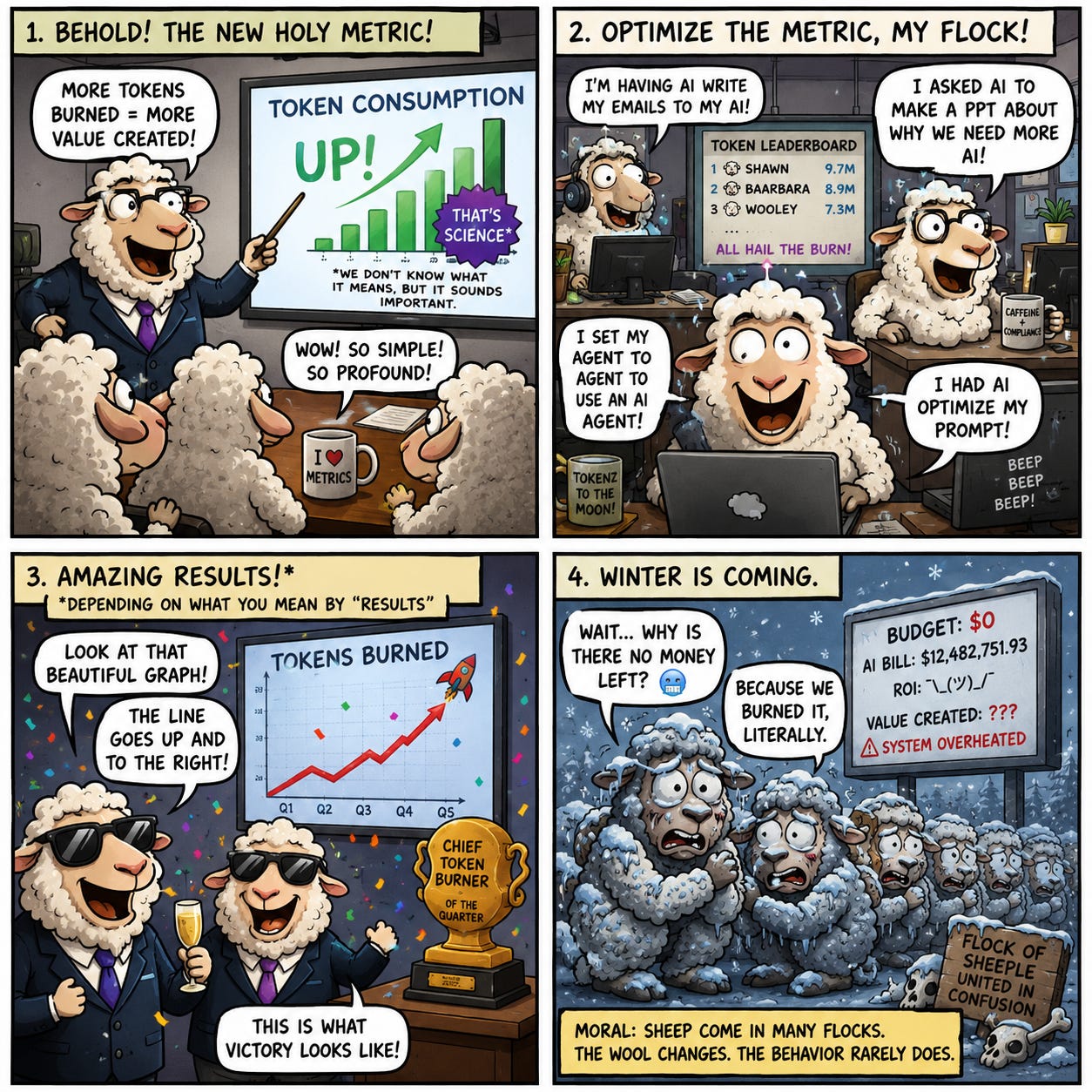
Invent a metric.
Confuse the metric with the goal.
Reward the metric.
Watch people optimize the metric.
Act surprised when the goal disappears.
In this case the metric was “tokens burned.”
Companies encouraged employees to use more AI. Some organizations reportedly created leaderboards. Employees responded rationally: if token consumption is rewarded, consume tokens. The result was engineers assigning pointless work to agents, excessive use of premium models, and organizations discovering that AI bills can become very real very quickly.
A funny story emerges from it:
The Many Flocks
The sheep were tired of being called sheep.
For years they had watched from the valley as executives stood on the mountain ridges, pointing at them.
“Look at those fools,” said the shepherds. “They follow trends.”
The sheep nodded.
The shepherds nodded.
Everyone felt very wise and in their place.
Then one spring, a consultant arrived carrying a shiny new metric called Wool Velocity.
The consultant explained:
“The future belongs to the flock that sheds the most wool.”
Nobody fully understood why.
But the chart was impressive, and investors and the market agreed, so the shepherds held meetings.
They appointed new roles and accountability.
Vice Presidents of Wool.
Directors of Wool Acceleration.
Chief Wool Transformation Officers.
Soon every sheep received a quarterly wool target.
The sheep complied.
Some shaved themselves twice a day.
Others hired goats to help.
A few entrepreneurial sheep began shaving neighboring sheep.
One legendary sheep shaved the entire hillside and became Employee of the Month.
The shepherds celebrated.
Graphs went up.
Dashboards glowed.
Awards were issued.
Then winter arrived.
And everyone froze.
The moral, of course, is not that sheep are foolish.
The moral is that shepherds are sheep with better parking.
Leadership often imagines itself as standing outside the crowd, observing the psychology of others.
Yet organizations repeatedly demonstrate that executives are vulnerable to the same forces seen in cults, social movements, and mass hysteria:
Social proof
Status competition
Fear of exclusion
Group reinforcement
Metric worship
Authority cascades
The difference is largely aesthetic.
A cult has robes. A corporation has Patagonia vests.
A cult has sacred texts. A corporation has PowerPoint decks.
A cult measures devotion. A corporation measures KPIs.
A cult asks, “How faithful are you?” A corporation asks, “How many tokens did you burn this quarter?”
The mechanism is remarkably similar.
The lesson from the token-burning era is not that employees behaved irrationally.
They behaved exactly as incentive systems predicted.
The more interesting question is why so many leaders collectively believed that token consumption was a proxy for value creation in the first place. Reports from multiple companies now suggest growing concern that AI usage metrics and actual business outcomes are not strongly correlated.
Perhaps the most dangerous flock is the one convinced it isn’t part of a flock at all.
The sheep come in many varieties.
Consumer sheep.
Political sheep.
Technology sheep.
Executive sheep.
AI sheep.
The wool changes. The behavior rarely does.