


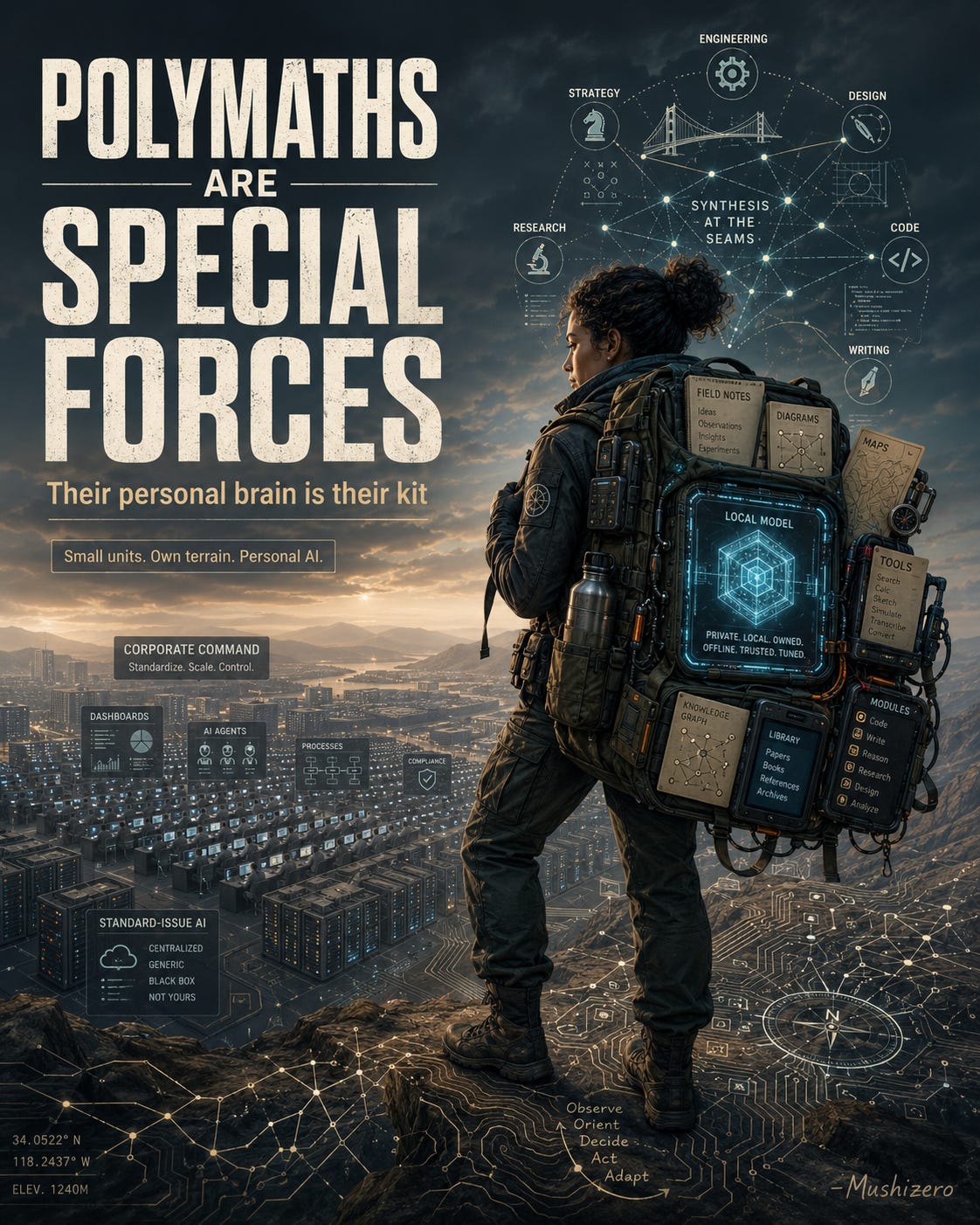
The follow-on argument: if self-hosted brains are how individual experts refuse to be captured, polymaths are how companies refuse to be out-thought. Both moves come from the same playbook, the one small forces have used to beat large ones for two thousand years. And both depend on the same piece of equipment: the operator’s own kit, carried on their own back, owned outright.
Why the conventional army loses
Mao codified it. T.E. Lawrence demonstrated it. Sun Tzu prefigured it. The pattern: a numerically and materially inferior force defeats a superior one by refusing to fight on the superior force’s terms. Mobility over mass. Local knowledge over doctrine. Initiative over hierarchy. Pick your terrain. Strike where the enemy isn’t. Disappear before they can mass.
Map to business: the conventional army is the Fortune 500 plus its AI agents. Massive headcount, massive compute, massive process documentation, massive replicability. The doctrine is scale. The bet is that any task done well enough at sufficient scale becomes a moat.
That bet is now wrong at the margins that matter. AI agents make scale cheap. When everyone has scale, scale stops being a moat. The remaining advantage is the work AI agents can’t do, work that requires synthesis across domains, judgment under genuine uncertainty, and the reframing of problems before they can be solved.
That work belongs to polymaths. And it depends on equipment they own.
The kit principle
Look at how actual special forces are equipped. Conventional infantries get standard-issue weapons, armor, and comms, interchangeable, replaceable, optimized for a force of thousands. Special forces operators get to select, modify, and personally maintain their own kit. Rifles tuned to the operator. Comms configured to the mission. Med pack curated to the operator’s training. Boots broken in to the operator’s feet. Knife of their choosing.
The reason isn’t vanity. It’s three things:
The operator is going to be alone. No quartermaster downrange. If the kit fails, the operator fixes it or dies. Equipment they didn’t choose and can’t service is a liability.
The mission is non-standard. Conventional kit is optimized for the average mission. Special forces missions aren’t average. Every load-out is a bet on terrain, duration, and threat profile that won’t be known to anyone but the team.
The operator’s judgment is the actual weapon. Everything else is just a tool that translates that judgment into effect. A tool the operator doesn’t fully understand, can’t modify, and doesn’t trust degrades the weapon that matters.
The polymath’s kit is their personal brain, their self-hosted model, their private corpus, their tool stack, the agents they’ve trained and tuned themselves. Same three reasons apply.
Why generic AI is conventional kit
Hyperscaler AI is standard-issue. It’s optimized for the average user across the average task. It’s serviced by someone else, on hardware the user doesn’t see, with a corpus the user didn’t curate, under terms the user didn’t write. When it works, it works for everyone. When it fails on the operator’s specific terrain, the operator has no ability to repair it, modify it, or even know why it failed.
For conventional work, the corporate equivalent of garrison duty, this is fine. For the work polymaths actually do, the joint problems, the cross-domain reframes, the high-uncertainty calls, generic kit is the wrong kit. It’s tuned to nobody’s terrain and trained on nobody’s specific judgment. It will be confidently wrong in exactly the places where the operator’s edge lives.
The polymath who runs on someone else’s brain is a special forces operator carrying conventional gear. They will be outperformed by a conventional soldier with the same gear, and they will be outperformed by a polymath with their own kit. Worst of both worlds.
What “personal brain as kit” actually means
Five operating principles of effective irregular forces, each mapped to a piece of the polymath’s kit:
Cross-trained, self-sufficient units. The operator carries everything they need to function autonomously. Kit equivalent: a local model that runs offline, on hardware the polymath owns, capable of reasoning, drafting, and tool use without phoning home. No cloud dependency means no single point of failure and no third-party logging of the operator’s reasoning.
Deep local context. Special forces know the terrain; conventional units consult a map. Kit equivalent: a private corpus of the polymath’s own work, notes, decisions, drafts, reasoning traces, source material from each of their domains. Indexed, retrievable, and never uploaded. This is the operator’s terrain knowledge, instantly queryable.
Mission command. Authority pushed to the lowest level with full situational awareness. Kit equivalent: an agent the operator has personally configured, with tools they personally selected, executing missions the operator personally scoped. No platform-imposed guardrails optimized for the average user. The operator decides what the agent can do, because the operator owns it.
Asymmetric targeting. Hit the joints, avoid the strengths. Kit equivalent: fine-tuning or custom RAG on the specific cross-domain seams the polymath operates in. A pure specialist’s hyperscaler model knows their domain shallowly. The polymath’s personal brain knows two or three domains deeply and the synthesis between them, because the polymath built that synthesis into the corpus and the prompts.
Disappearing footprint. Leave nothing behind that can be exploited. Kit equivalent: outputs leave the operator’s environment; weights, corpus, and reasoning traces don’t. When the engagement ends, the client has the deliverable and nothing else. No training signal extracted. No agent to be re-rented to a competitor. No reasoning logs sitting in someone’s data warehouse waiting for a subpoena.
Why polymaths specifically need this
Polymaths are not generalists. A generalist knows a little about a lot. A polymath has multiple deep specialties, and the cognitive habit of moving between them. The value isn’t breadth. The value is the synthesis that becomes available when two or more deep frames touch.
That synthesis is exactly what generic AI can’t do for the polymath. Hyperscaler models are trained on the average of all corpora. They produce the average synthesis, which is no synthesis at all, because the interesting synthesis lives at the specific intersection the polymath has spent years learning to see. A model trained on everything is, on the polymath’s specific terrain, trained on nothing in particular.
The polymath’s personal brain is the only model that can be trained on the specific intersection the polymath actually works in. That makes it the only model that can amplify, rather than dilute, the polymath’s edge.
This is the bridge back to the prior piece. Self-hosted brains protect the expert at the physics layer, weights and corpus never leave the operator’s machine. Polymath cognition protects the expert at the epistemic layer, the synthesis can’t be reproduced even if the weights leaked. The two stack. A self-hosted polymath is an expert whose kit is on their own back and whose value is in cognition no scraper can copy by watching from the outside.
Why companies need this kind of operator
Most companies don’t have a special forces tier. They have departments. Departments are good at running known plays at scale. They are systematically bad at:
Recognizing that the play has changed.
Operating across departmental boundaries fast enough to matter.
Doing novel work where the success criteria themselves have to be invented.
In a stable environment, this is fine, departments win on efficiency and the cost of polymaths is unjustified. In an unstable environment, which is what AI is creating across nearly every white-collar industry, departments are the wrong unit. They optimize for the world that just ended.
Special forces don’t replace the conventional army. They operate in front of it, beside it, sometimes through it. Their job is the work the army can’t do: reconnaissance into ambiguous terrain, deep strikes against high-value targets, rapid response to situations that don’t fit doctrine. The army holds territory. Special forces make holding territory worth doing.
A company that wants this capability has to accept the kit principle along with it. You cannot deploy a polymath unit on standard-issue corporate AI. The whole point is that the operators are running gear no one else has, tuned to terrain no one else fully sees. Issuing them the same agents you issue to customer support defeats the purpose. The unit’s edge is the kit.
The honest counterarguments
“Personal kit doesn’t scale.” Correct. Special forces don’t scale either. That’s the point. You don’t deploy SEAL Team Six for customer support, and you don’t run a polymath unit’s personal brains on the CIO’s standardized stack. Scale lives in the conventional army; edge lives in the kit.
“Specialists go deeper.” True, in their lane. But depth-in-one-lane is the kind of cognition AI agents replicate fastest, because it’s a workflow. The non-commoditized work requires multiple lanes simultaneously, which is exactly what a polymath’s personal brain, fine-tuned on multiple corpora the polymath actually owns, is structured to do.
“It’s hard to hire polymaths.” Yes, because resumes and job ladders are built around specialists. Companies that win the next decade will build the recognition machinery: interview loops, project structures, and comp models that surface and retain people whose value is cross-domain and who already operate with their own kit. Most won’t. That’s the opportunity for the few that do.
“Why not just give them better corporate tools?” Because the moment the tools are corporate, the kit is no longer the operator’s. Weights live in the company’s cloud. Corpus is the company’s IP. The polymath leaves and the kit stays, meaning the operator’s actual capital has been quietly converted to corporate inventory. Same brain-scraping pattern, executed inside the firewall instead of outside it. The operator brings their kit; the company doesn’t issue it.
Tactical implications for companies
Create a small, named unit. Not a department. Five to fifteen people, cross-disciplinary, reporting to the CEO or a named executive sponsor. Give it a charter, not a roadmap.
Provision for personal kit, don’t standardize it. Budget for hardware the operator owns or controls. Allow open-weights tooling, local fine-tuning stacks, and private corpora. Resist the IT impulse to put everything on the corporate cloud “for security.” Security is an argument; capability is the mission.
Authority over information, not authority over headcount. Polymaths need access to the places where decisions get made early. Then get out of their way.
Project selection by joint, not by department. The unit’s portfolio is problems no department owns. If a problem fits cleanly into one department, it doesn’t belong here.
Compensate for outcomes, not titles. Polymath comp packages should look more like founder equity than band-defined salary. They are doing the work that, on the outside, would be a startup.
Write the IP terms honestly. Deliverables belong to the company. The operator’s kit, their personal model, their private corpus, their fine-tunes, does not. Put it in the contract. A company that tries to claim the kit will lose the operators who matter, exactly as the prior piece predicted.
Tactical implications for the polymath
Build your kit before you need it. Stand up a local model. Curate your private corpus. Wire your tools. Don’t wait for an employer to provision this, they won’t, and if they do, it isn’t yours.
Make the synthesis legible. Your value is invisible if you only describe it in one domain’s vocabulary. Narrate the cross-domain move so non-polymaths can see it happening. Your kit makes the synthesis faster; your communication makes it visible.
Treat your corpus as capital. Notes, decisions, drafts, reasoning traces, these are the training data only you have. Back them up to hardware you own. Encrypt them. Update them weekly. This is the asset that compounds.
Pick terrain, not tasks. Choose the joint you want to live in, the seam between two or three domains where the most valuable problems are emerging. Tune your kit to that terrain.
Carry your kit between engagements. The deliverable is what the client gets. The kit travels with you. Negotiate accordingly. “Model and training data remain property of [you]” is a clause, not a moonshot.
Find the other irregulars. Special forces operate in teams. Polymaths are isolated by default because no department fully claims them. The remedy is a peer network, internal, external, or both, of people running their own kit on adjacent terrain. Federated discovery only works if there’s a federation.
The wedge, restated
The conventional bet: scale plus standard-issue AI plus process equals victory. The insurgent bet: small units of cross-trained operators, each running their own personal brain on terrain they know cold, can repeatedly hit the joints the conventional bet can’t defend.
[Pattern-based] Asymmetric forces have been beating conventional ones since the Peninsular War, the American Revolution, the Boer War, Vietnam. The pattern survives technological revolutions because the pattern is the technology, it’s an organizational design plus an equipment philosophy, not a weapon. AI agents don’t change the pattern. They make the kit principle more important, not less. When everyone has access to a model, the advantage goes to whoever has their own model, tuned to their own terrain, carried on their own back.
Pick your role. Either you’re issuing standard-issue brains to a conventional army that will be efficient at the war that just ended. Or you’re building, and joining, the special forces unit that will fight the one that just started, with kit nobody else has and nobody else can take.
The polymath isn’t a luxury hire. The polymath with their own brain in their own ruck is the unit of force that wins this decade.
This piece extends the argument in the prior post on self-hosted brains, which itself builds on John Wolpert’s How to Own Your Brain at Work. Self-ownership of cognition is the precondition. Personal kit is how you carry it. Polymath operating model is what you do with it.