


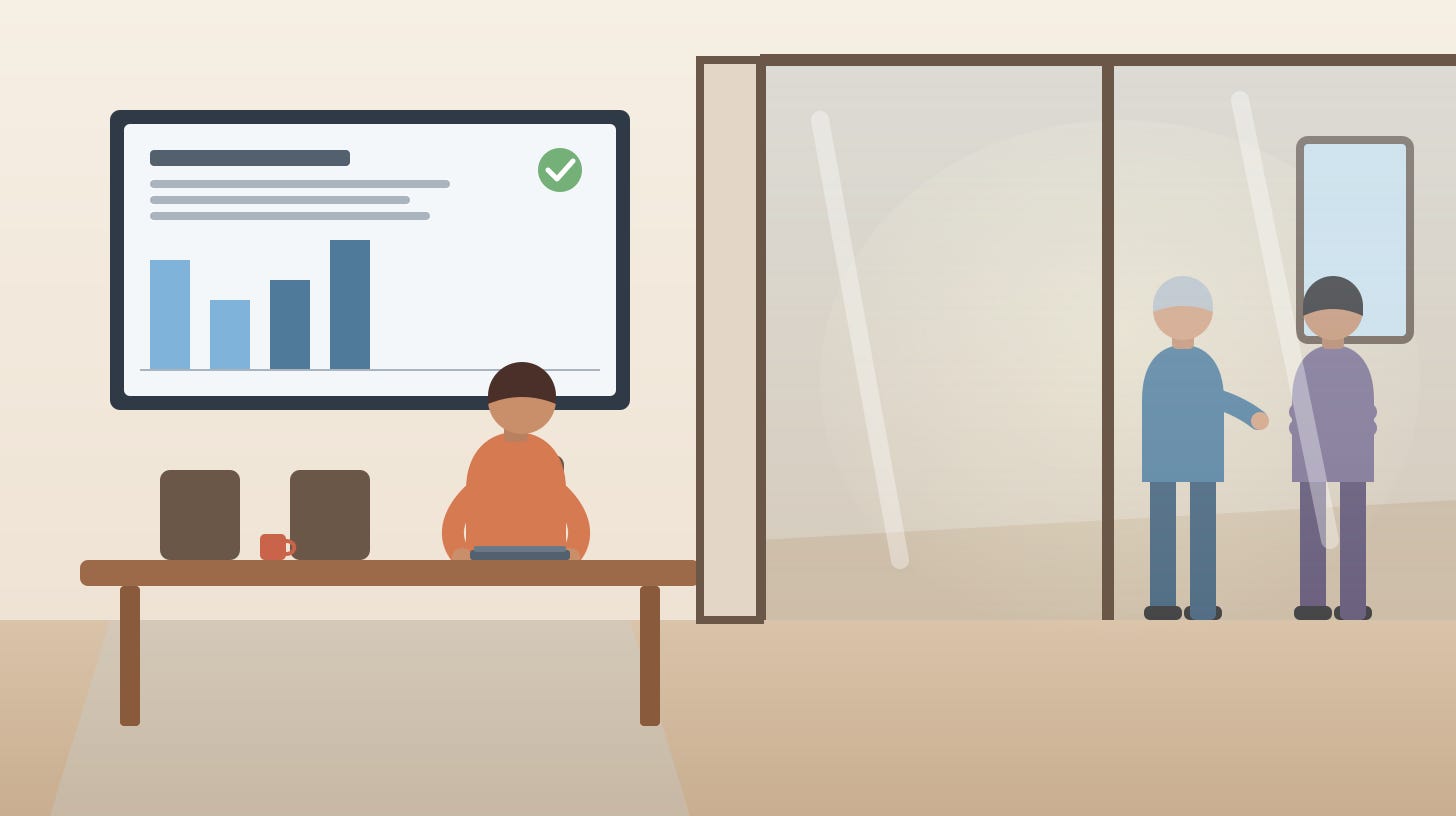
The deck was perfect
Maya is eight months into her first real job. She is a composite, but every piece of her is someone I have met this year.
She was asked to put together a recommendation on whether her team should consolidate two vendor contracts. She did what she has always done. She fed the contracts, the usage data, and three years of invoices into a model, asked it the right questions, pushed back on its first answer, and had a twelve-slide deck by Thursday that would have taken her predecessor two weeks. The analysis was correct. The formatting was clean. The executive summary said exactly what the data said.
The meeting lasted twenty minutes. The finance director asked one question about the transition cost. The operations lead said something about a relationship with the smaller vendor that went back a decade. Her manager said they would take it offline. Nobody disagreed with a single number. Nothing happened.
She walked back to her desk and could not name what had gone wrong, because nothing in the deck had. She had been in the room. She had not been in the room where it was decided, and she did not know that room existed.
What she is good at
Maya is better at the tool than anyone over forty on her floor. That is not arrogance. It is just true, and everyone knows it, and it is the reason she was hired.
She can take a vague request and turn it into a precise question. She knows when the model is confident and when it is performing confidence. She iterates without ego because the draft was never hers in the first place. She can produce in an afternoon what used to be a junior analyst's whole quarter, and she can do it in a domain she learned about that morning.
What nobody told her, in four years of school and eight months of work, is that none of this is the job. It is the part of the job that used to be the job. The thing she was hired to grow into is everything that happens after the deck is done, and she has had exactly zero reps at it.
Her predecessor got those reps by accident. He spent two weeks in the invoices and in that time he talked to the operations lead three times, heard the vendor story, learned that the finance director always asks about transition cost, and quietly reshaped the recommendation before it ever hit a slide. He did not know he was learning the organization. He thought he was building a spreadsheet.
Maya built the spreadsheet in an afternoon. The two weeks of accidental education were optimized away, and no one replaced them with anything.
Owning what you cannot defend
There is a specific feeling that Maya's generation has and mine did not, and it deserves a name.
It is the feeling of signing your name to work you did not fully do, being praised for it, and knowing that if anyone senior pushed hard on slide seven you would have nothing. Not because the slide is wrong. Because you could not say why it is right. The model knows. You approved.
She does not talk about this. Nobody does. Admitting it feels like admitting you are a fraud, when in fact it is the predictable result of being handed a very good tool and no one to stand next to while you use it. The tool produces competence-shaped output. It does not produce competence. The gap between the two is invisible from outside and enormous from inside, and she is the only one who can see it.
So she compensates. She over-prepares for questions that never come. She avoids volunteering for things where she might be asked to reason live. She stays in the lane where her output speaks for her, which is exactly the lane that is narrowing. The research on this is blunt: entry-level roles in exposed fields are increasingly asking for judgment and leadership on day one, and the people filling them have had the fewest chances to practice either.
Maya is not failing. She is doing what the system set her up to do, perfectly. The system just forgot to include the part where someone teaches her what the output is for.
The one who said it out loud
What changed for Maya was not a program. It was one person, and it was an accident.
A director two levels up, someone she had barely spoken to, asked her to sit in on a call with a partner who was unhappy. Not to present. Just to be there. Afterward he walked her back and, unprompted, told her what she had just watched.
The partner was not angry about the thing he said he was angry about. The real issue was that he had been surprised in front of his own boss three weeks earlier, and this call was about making sure that never happened again. The director had let him talk for eleven minutes without interrupting because the talking was the point. The concession he offered at the end was one he had decided on before the call started. He had held it back so it would land as a response rather than an opening.
None of this was in any document. None of it could have been. Maya had watched the whole call and seen a polite conversation about delivery dates.
That was the moment she understood what she had been missing. Not information. The reasoning underneath the information, which lives only in the heads of people who have done the thing many times, and which comes out only when one of them decides to say it.
She asked if she could sit in again. He said yes. It has been four months. She is not fluent yet, but she can now watch a meeting and see two of them: the one that is said and the one that is happening. That is the whole skill. It took one person narrating his thinking for twenty minutes to open the door to it.
What she would ask for
I asked several people in Maya's position what they would want from the senior people around them, if asking did not feel like confessing a weakness. The answers were consistent and they were not what the senior people expected.
They did not want career advice. They have more of that than they can use, and the model gives it too.
They did not want a formal mentor assigned by HR with a kickoff lunch and a quarterly check-in. Several had been through one. The word that came up was "polite."
What they wanted:
Let me in the room. Not to present. To watch. Then tell me what I saw.
Say your reasoning out loud. When you decide not to send the email, say why. When you take a meeting you could have skipped, say why. The decision is the artifact. The reasoning is the lesson, and it evaporates the moment you make it unless someone hears it.
Ask me what my work is resting on. Not to catch me. So I learn to ask myself. The first time someone asked me what slide seven was built on and waited for an answer, I understood what owning something means.
Let me be wrong somewhere cheap. I will be wrong in front of a customer eventually. I would rather be wrong in front of you first.
Do not make it a program. Make it a habit. One hour a week with someone who has actually done it is worth more than a curriculum.
Every one of those is free. None of them require a budget line or a steering committee. They require a senior person deciding that their reasoning is worth narrating and that the graduate two desks over is worth narrating it to.
To both sides of the table
If you are Maya: the gap you feel is real, and it is not yours. You were handed the fastest tool anyone has ever had and dropped into an organization that quietly deleted the two weeks where you would have learned what the tool was for. You are not behind. You are early, and the thing you are missing cannot be downloaded. It has to be handed to you by a person. So find the person. Ask to sit in. Ask what you just watched. The ones worth learning from will say yes, and they will be more flattered than you expect.
If you are the person: the graduate two desks over is better at the tool than you and worse at everything the tool cannot do. That is not a problem with them. That is the job you are now for. You have something they cannot get anywhere else, and it only transfers if you decide to say it out loud.
Maya did not need a program. She needed twenty minutes in a hallway with someone who told her what she had just seen.
She still thinks about that call. Somewhere, there is a graduate who is going to think about yours.