


Who this is for: Executives, chiefs of staff, and organizational designers deciding whether the drift-detection system described in the practitioner’s guide deserves a standing home, and if so, what to build, where to put it, and how to keep it from becoming the bureaucracy it exists to prevent.
The claim: Between strategy formulation and program execution sits a coordination discipline that most organizations assign to everyone and therefore to no one: keeping strategic intent intact as it crosses organizational boundaries. This document defines that discipline as a function, its charter, operating model, reporting line, authority, measurement, and failure modes.
1. Why a Function, and Why Now
The practitioner’s guide proved a point by construction: one person with a spreadsheet can define intent operationally, instrument handoffs, score drift, and route corrections to the right layer. When that works, the organization does not conclude the problem is solved. It discovers the problem was real, load-bearing, and previously invisible.
This is a recurring pattern in organizational history. Finance existed long before FinOps; revenue existed long before RevOps; both functions emerged when a coordination problem outgrew heroic individual effort. The trigger is always the same: the cost of not coordinating becomes visible, and the work of coordinating exceeds what any line role can absorb as a side job.
The empirical case is well established. Sull, Homkes, and Sull found that strategy execution fails predominantly at horizontal boundaries — managers can rely on their own bosses and teams, but not on commitments from other functions — and that this coordination gap, not vertical cascading, is where execution unravels (HBR, 2015). Organizations respond to that gap with more communication, more governance, or more planning. All three miss, because the failure is not in the message, the controls, or the plan. It is in the translation layer, and no one owns the translation layer.
When not to build it: A single-business-unit company under roughly 500 people does not need this function; it needs the practitioner’s guide and a leadership team that runs variance reviews honestly. Intent coordination earns a standing home when three conditions co-occur: multiple business units or product lines interpreting the same strategy, workflows that cross three or more organizational boundaries before reaching a customer, and a track record of initiatives that succeeded locally while the enterprise outcome stalled. Two of three, wait. Three of three, the function already exists informally — it’s just uninstrumented, unpaid, and burning out whoever is doing it.
2. The Charter
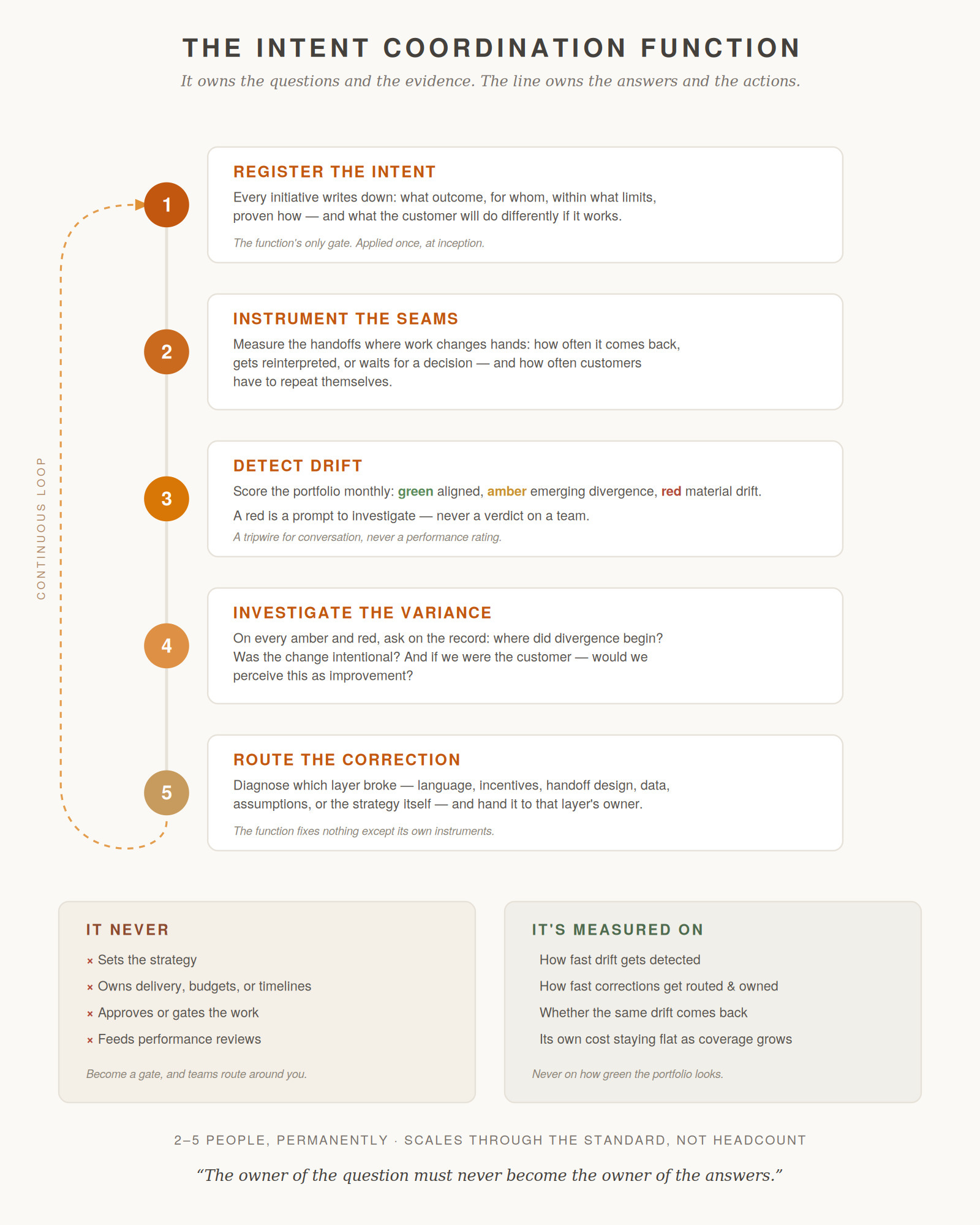
Intent coordination owns the integrity of strategic intent across organizational boundaries. Concretely, five accountabilities:
Intent definition standards. Every funded initiative carries an intent statement answering the five questions: what outcome, for whom, under what constraints, with what evidence, and what customer behavior changes if it succeeds. The function owns the standard and the registry, a single place where every initiative’s intent, its KPI tree, and its owner are recorded and versioned.
Handoff instrumentation. The function defines and maintains the measurement of organizational seams: return rates, reinterpretation rates, decision latency, and customer context loss. Not the workflows themselves, the instrumentation of their boundaries.
Drift detection. The function operates the Strategic Drift Index across initiatives, maintains scoring consistency, and triggers investigation when divergence emerges. It runs the variance review discipline: the seven questions, applied to ambers and reds.
Ownership arbitration. The function runs the quarterly Ownership Drift Test and surfaces disagreements — the cases where sales, product, services, and support each reasonably believe they own an outcome that consequently no one owns. It does not assign ownership; it forces the assignment decision to whoever holds that authority, with evidence attached.
Correction routing. When drift is confirmed, the function diagnoses the layer, language, incentives, handoff design, data, assumptions, or strategy itself, and routes the correction to the owner of that layer. It fixes nothing directly except its own instrumentation.
Equally important is the negative charter — what the function explicitly does not own:
It does not set strategy. Intent originates with executive leadership; the function translates and protects it.
It does not own delivery. Programs, budgets, and timelines remain with the PMO and line functions.
It does not own the metrics themselves. Business units own their numbers; the function owns the tree, the causal linkage from drivers to outcomes to guardrails.
It does not approve anything. The moment intent coordination becomes a gate, it becomes a bottleneck, and teams will route around it exactly as they route around every other gate.
3. How This Differs From the Office of Strategy Management
The closest prior art is Kaplan and Norton’s Office of Strategy Management (HBR, 2005), a unit that manages the scorecard, aligns the organization, and integrates strategy into planning cycles. Intent coordination inherits the OSM’s central insight (strategy execution needs a process owner) and departs from it in three ways:
Direction of attention. The OSM manages the cascade downward: communicating strategy, aligning units to it, reviewing progress against it. Intent coordination instruments the translation at each boundary, it assumes interpretation is inevitable and makes it visible, rather than assuming communication can prevent it. Its posture is closer to mission command (Bungay, 2011): specify intent and boundaries centrally, let method vary locally, and detect when local method has quietly changed the outcome.
Unit of analysis. The OSM’s unit is the initiative and the scorecard. Intent coordination’s unit is the handoff, the transition where context is lost, ownership blurs, and drift enters.
Relationship to the plan. The OSM’s failure mode is fidelity to a stale plan. Intent coordination measures fidelity to the outcome and treats plan changes as healthy when deliberate; its variance review exists precisely to distinguish deliberate adaptation from accidental mutation (a distinction Mintzberg and Waters drew between deliberate and emergent strategy in 1985, the function’s job is making emergence conscious).
If your organization already has an OSM or strategy realization office, do not build a parallel function. Extend the existing one with the handoff instrumentation, the drift index, and the ownership arbitration mandate. The name matters less than the charter.
4. Reporting Line and Shape
Three viable placements, in order of preference:
Chief of Staff / Office of the CEO. Best default. The function needs cross-functional reach without belonging to any function it instruments, and it needs its evidence to land where trade-off authority lives. Risk: perceived as executive surveillance. Mitigation: the transparency rule in §6.
COO organization. Works when the COO genuinely owns cross-functional operations rather than a subset of delivery. Risk: drift questions about the COO’s own operations get muted. Mitigation: the quarterly intent validation reports to the full executive team, not the COO alone.
Strategy office. Acceptable, with one hazard: the function must be free to conclude the strategy itself is the drift source (correction layer six). Housing drift detection inside the group that authored the strategy creates an obvious conflict. If placed here, the escalation path for strategy-layer findings must bypass the strategy office.
Never place it in: the PMO (it will collapse into status reporting), finance (every drift question becomes a cost question), or any single business unit (instant capture, the function will see every other unit’s drift clearly and its host’s not at all).
Shape: Small, permanently. Two to five people at enterprise scale, a lead who can sit in executive reviews as a peer, and analysts who maintain the registry, the instrumentation, and the index. Headcount growth is itself a red flag; this function scales through the standard and the cadence, not through people. If it is hiring, it is probably doing line work it should be routing.
5. The Authority Model
The function’s authority is deliberately narrow and of a specific kind: convening authority plus evidence, not command authority. It can compel three things:
An intent statement. No initiative enters the portfolio without one that passes the five-question standard. This is the function’s only hard gate, applied once, at inception.
An investigation. A red drift score obligates the accountable owner to answer the seven variance questions within a defined window. The function cannot dictate the answer; it can require that the question be answered on the record.
An escalation. When ownership arbitration or a strategy-layer finding stalls, the function has a guaranteed path to the executive team with the variance data attached.
Everything else, reassigning ownership, changing incentives, redesigning handoffs, revising strategy, belongs to line and executive leadership. The division is clean: the function owns the questions and the evidence; the line owns the answers and the actions. This is what keeps it a coordination function rather than a control function, and it is the design choice most likely to be eroded first. Guard it.
6. Measuring the Function Without Goodharting It
The trap: measure intent coordination on “portfolio greenness” and it will produce green portfolios, by softening scores, narrowing instrumentation, or negotiating ambers. The function that polices Goodhart’s law (Strathern, 1997; Muller, 2018) must be designed as if its own metrics will be gamed, because they will.
Measure it on the health of the process, never the color of the results:
Detection latency. Time from divergence beginning (established retrospectively) to divergence flagged. Shrinking latency means the instrumentation works.
Correction cycle time. Time from red score to a routed, owned correction decision, not to resolution, which belongs to the line.
Drift recurrence. How often the same drift source reappears in the same seam after correction. Recurrence means the correction hit the wrong layer.
Diagnostic accuracy. Sampled retrospectives: when the function attributed drift to incentives or language or handoff design, was it right?
Cost of the function itself. Total hours the organization spends feeding the system, registry updates, scoring, reviews. If this grows year over year, the function is becoming the bureaucracy. A healthy trajectory is flat or declining coordination cost against expanding coverage.
One asymmetry worth institutionalizing: reward found drift. A function measured on how good things look will hide problems; a function whose credibility grows each time it surfaces real divergence early will hunt for them. The executive team’s behavior in the first three red scores, curiosity versus blame, will determine which function they get.
7. Failure Modes
The bureaucracy it exists to prevent. Symptoms: the intent-statement gate grows sub-criteria, reviews multiply, templates thicken. Countermeasure: a standing sunset rule — every artifact and cadence the function operates is re-justified annually against the coordination-cost metric, and anything that cannot show a governed decision is retired.
Strategy police. The function starts treating the plan as the thing to protect and adaptation as violation, the exact inversion of its purpose (Martin’s “execution trap,” HBR 2010). Countermeasure: variance question 4 (”was the change intentional?”) stays the pivot; deliberate, intent-serving changes are logged as adaptations, never as findings.
Reporting factory. The function drifts into producing beautiful decks about drift instead of routing corrections. Countermeasure: correction cycle time is the headline metric, not report volume; no artifact exists that is not attached to a decision request.
Functional capture. One organization, usually the host, shapes what gets instrumented. Countermeasure: seam coverage is reviewed by the executive team annually; the function’s own host is instrumented first, publicly.
Shadow strategy office. With all the evidence in hand, the function starts recommending strategy rather than surfacing findings. Countermeasure: the negative charter, enforced by the reporting line. The day the function’s lead argues for a strategic direction rather than presenting variance, the authority model has broken.
Surveillance perception. Teams experience instrumentation as monitoring and begin managing signals. Countermeasure: radical transparency, every metric the function collects is visible to the teams it describes, scoring rationale is open, and the index never touches performance management. This rule is load-bearing; the first exception ends honest data permanently.
8. The First Twelve Months
Quarter 1 — Charter and registry. Ratify the charter (including the negative charter) at the executive level. Stand up the intent registry; backfill intent statements for the top ten initiatives by investment. Expect this to surface immediate findings: initiatives whose intent cannot be stated are the first drift candidates.
Quarter 2 — Instrument two seams. Pick the two cross-boundary workflows most coupled to enterprise outcomes. Deploy the four handoff metrics. Run the first Ownership Drift Test and deliver its disagreement map to the executive team without recommendations attached.
Quarter 3 — Cadence live. Drift index scored monthly across the registered portfolio; variance reviews running on ambers and reds; first corrections routed with layer diagnoses. Begin measuring detection latency and correction cycle time.
Quarter 4 — Prove restraint. Publish the function’s own scorecard, including its coordination cost. Retire at least one artifact or review that failed the sunset test. The most credible thing a new coordination function can do in its first year is visibly decline to grow.
The Standard
The practitioner’s guide ended with a question one person can ask: can we prove that execution still serves the intended outcome? A function exists when the organization decides that question deserves an owner, an instrument, and a guaranteed path to power, and accepts the discipline that the owner of the question must never become the owner of the answers.
Strategy will keep degrading one reasonable decision at a time. The only real choice is whether anyone is positioned to notice.
Sources
Sull, D., Homkes, R. & Sull, C., “Why Strategy Execution Unravels — and What to Do About It,” Harvard Business Review, 2015.
Kaplan, R. & Norton, D., “The Office of Strategy Management,” HBR, 2005.
Bungay, S., The Art of Action, 2011.
Mintzberg, H. & Waters, J., “Of Strategies, Deliberate and Emergent,” Strategic Management Journal, 1985.
Martin, R., “The Execution Trap,” HBR, 2010.
Strathern, M., “’Improving Ratings’: Audit in the British University System,” 1997; Muller, J., The Tyranny of Metrics, 2018.
Second in the series. Companion to “Strategy Does Not Fail at the Top. It Degrades on the Way Down.” and “Detecting Strategic Drift: A Practitioner’s Guide.”