


I have spent much of my life being the person supposedly in control.
Founder. CEO. Executive. Leader. Educator. Architect. Husband.
Titles that suggest authority. Positions that imply command. Roles that carry the expectation that you know where you’re going, how you’re going to get there, and what happens next.
And after a lifetime of building companies, developing technologies, raising capital, leading people, and teaching others how to do the same, I’ve arrived at a rather inconvenient realization.
I was responsible for many things. I was never actually in control of most of them.
There is a distinction you learn as a parent.
Early in my career, I helped build companies from ideas that existed largely in our imaginations. We convinced investors to believe in futures that hadn’t happened. We raised money, built teams, created products, and made promises about markets we thought we understood.
At Neoforma, that journey reached the public markets. An IPO. One of those milestones the business world uses to validate a particular version of success.
But an IPO doesn’t mean you controlled the journey. It means enough people, circumstances, decisions, and opportunities converged to produce an outcome you had worked toward.
We could influence it. We could prepare for it. We could work relentlessly to make it possible.
We could not command it into existence. But man did we try!
I went on to found companies of my own. I sat in the CEO’s chair. I made decisions that affected employees, investors, customers, and families. I carried the responsibility of knowing that others were depending on my judgment. Or that patients were healed.
There is something almost comical about being called the Chief Executive Officer.
Chief. Executive. Officer.
Three words arranged to suggest that someone is firmly at the controls.
Yet every founder eventually encounters the same uncomfortable truth: the market doesn’t report to you. Timing doesn’t take direction. Customers have their own priorities. Technology doesn’t respect your calendar. And tomorrow has never attended a board meeting.
Leadership, I discovered, wasn’t the ability to control outcomes. It was the willingness to remain accountable when outcomes refused to cooperate.
That distinction became even more interesting when I began teaching.
At Berkeley, I had the privilege of working with entrepreneurs and engineers, people preparing to build the next generation of things that don’t yet exist.
Imagine the irony.
A man who had spent decades confronting uncertainty was now teaching others how to navigate it.
We teach strategy, execution, financing, engineering, and leadership. We draw diagrams. We build models. We identify milestones and define success.
All useful.
But somewhere between the business plan and the actual business, reality gets a vote.
Sometimes it votes no.
Sometimes it offers something you never imagined asking for.
The most important lesson may not be how to guarantee success, but how to develop the judgment, resilience, and intellectual humility to act without that guarantee.
Over time, my work evolved from building companies to designing systems, securing technologies, advising leaders, and examining the growing relationship between human judgment and artificial intelligence.
The problems became more sophisticated. The tools became more powerful. Our ability to model, predict, and influence outcomes improved dramatically.
Yet the underlying human condition remained stubbornly unchanged.
We have become extraordinarily good at constructing the appearance of control.
Our dashboards measure it. Our organizations institutionalize it. Our titles reinforce it. Our technologies promise more of it.
And still, the next moment arrives without asking permission.
That brings me to fame.
Not necessarily celebrity. Fame can be as modest as being recognized in one’s profession, remembered for a contribution, or known by people whose respect matters.
I’ve spent a lifetime pursuing ideas worth making real. Sometimes the work brought recognition. Sometimes it brought responsibilities. Sometimes it produced results quite different from those originally intended.
But there’s a difference between choosing what we want to be known for and choosing what the world will remember.
We don’t own the interpretation of our lives.
Others participate in writing that story.
And even if we could somehow arrange our entire legacy exactly as we wished, we would still face the same astonishing limitation.
We cannot command the very next moment.
So what does that make a lifetime of ambition?
Was it all an illusion?
I don’t think so.
The work was real. The people were real. The consequences were real. The accomplishments and disappointments mattered. Patients were healed.
The illusion was never that our choices had meaning.
The illusion was believing that meaningful choices entitled us to predetermined outcomes.
There is a peculiar freedom in recognizing this.
I no longer have to confuse responsibility with omnipotence, planning with prediction, or recognition with worth.
I can still build. Still teach. Still question. Still pursue difficult ideas. Still challenge assumptions, including my own. Especially my own.
I can exercise judgment without demanding certainty.
I can have intentions without requiring the universe to endorse them. Or an LLM to flatter them.
And perhaps most importantly, I can be present for the life that is actually happening instead of perpetually negotiating with the one I’ve imagined and was actively trying to will I to existence.
I have spent decades thinking about what comes next. The next company. The next technology. The next breakthrough. The next challenge. The next opportunity to leave something meaningful behind.
Now, reflecting on the life that brought me to this particular moment, I find myself facing a much smaller and considerably more profound question.
What if this moment was never merely the bridge to the next achievement?
What if it was the life itself?
The founder in me still wants to create.
The CEO still wants to execute.
The leader still wants to make a difference.
The educator still wants to leave someone better equipped to think for themselves.
I don’t need to abandon any of them.
I simply need to recognize what none of those titles ever gave me; Control over what comes next.
And perhaps that is the lesson it took an entire career to appreciate.
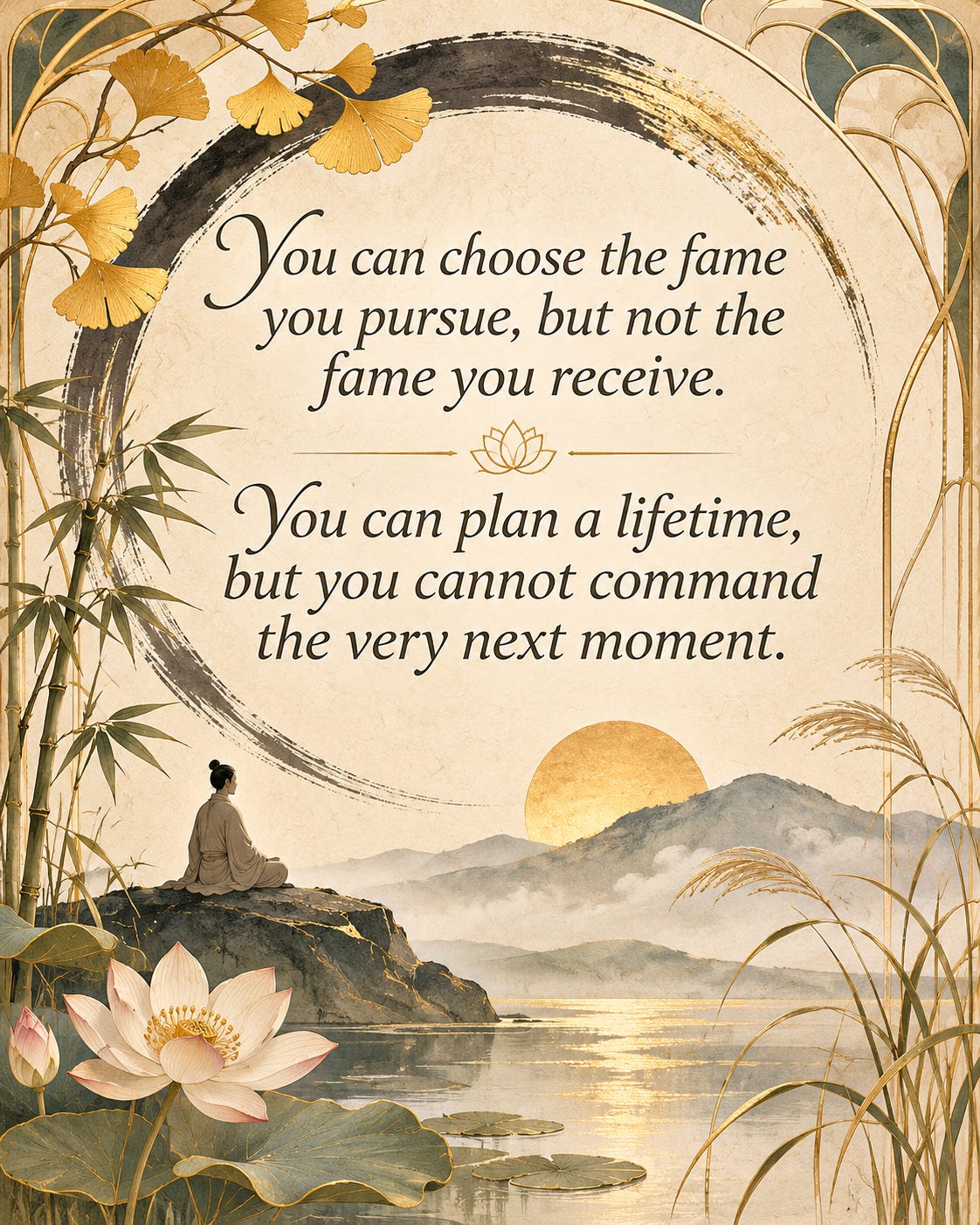
You can choose the fame you pursue, but not the fame you receive.
You can plan a lifetime, but you cannot command the very next moment.
I spent a lifetime learning to lead what I could influence.
I am learning to live without needing to command the rest. Thank you for being in the moment, what’s next?