


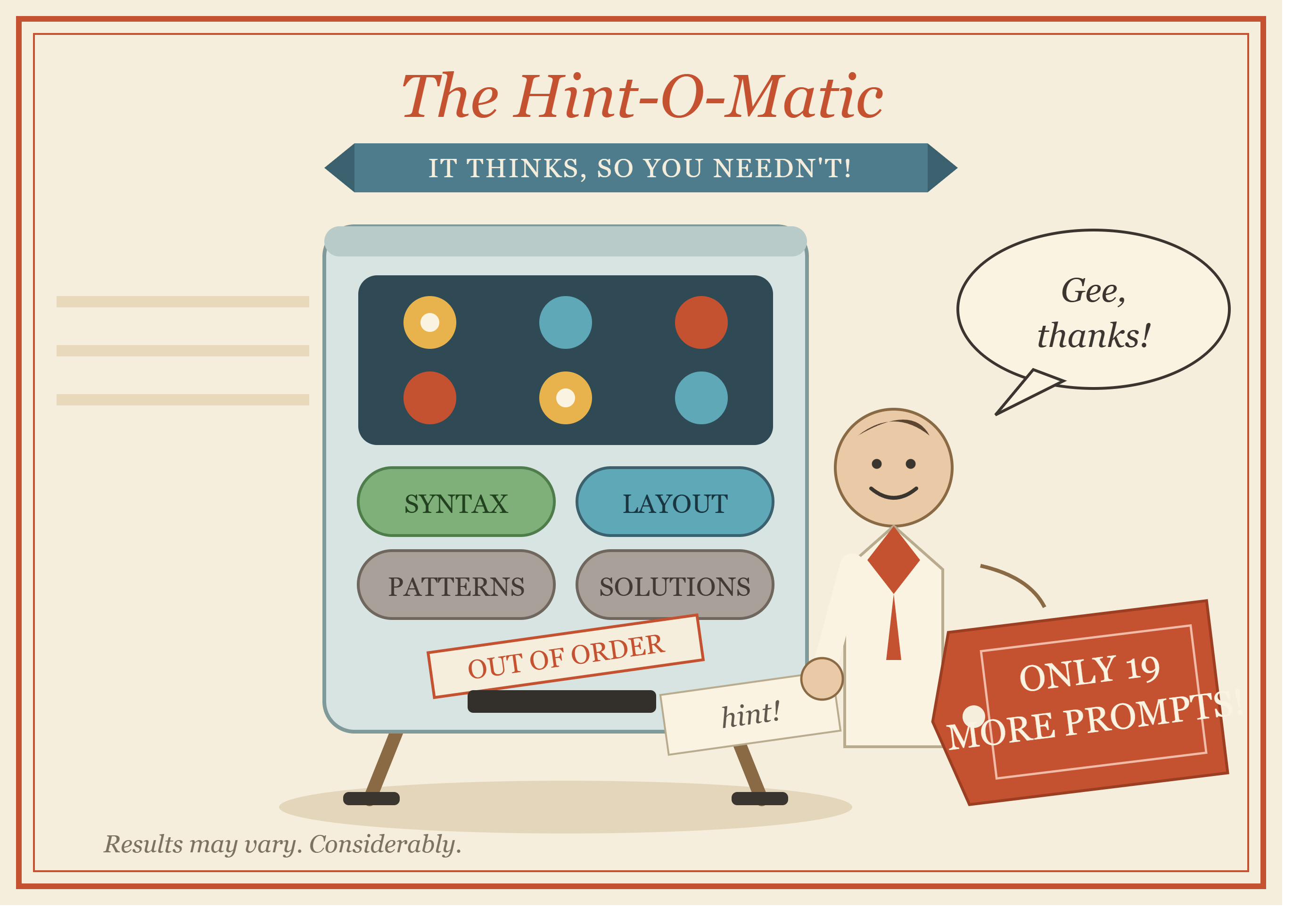
I know what forgetting looks like because I have done it. You start negotiating with the thing. You rephrase. You coax. You read tone into a text generator. Twenty minutes later you have four versions of an answer and no answer, and the ticket you opened the tab for has not moved.
A tool gets judged one way. Did the hour I gave it come back with interest. So, run the audit with me. Not on the demos. On the week.
The hour it earns
There is one job this tool does that survives contact with production. It hands you a hint.
Stuck on an obscure error, it gives you three directions in ten seconds. Facing an unfamiliar API, it sketches the shape of a solution before your coffee cools. That is real. That is an hour earned, ten seconds at a time. The 2025 Stack Overflow survey, 49,000 developers, shows the field already voted with its feet: search and explanation are the number one use, while three quarters of developers refuse to let AI anywhere near deployment and monitoring. Practitioners sorted this out before the vendors did. It points. It does not arrive. You still walk the path yourself, but you stop wandering.
The mistake is promoting the hint to a solution. A hint is a direction. A solution is a direction plus your architecture, your constraints, your history, your pager. The tool holds none of those.
The hour it steals back
Ask it for structure and it delivers. Scaffolding, layouts, boilerplate, the skeleton of a service. Clean and fast. Then ask it to work inside your Python codebase and watch the refund get clawed back.
It does not hold patterns. It does not know the retry logic already lives in one module because three of us bled for that decision last year. It writes a fresh copy, and the copy runs, and that is the trap. Sixty-six percent of surveyed developers name it as their top frustration: almost right, but not quite. Forty-five percent say debugging the output costs more than it saved. GitClear watched this happen across hundreds of millions of changed lines. Refactoring collapsed from a quarter of all changes to under ten percent. Copy-paste passed reuse for the first time on record. Duplication is up 81 percent against pre-AI baselines.
Every one of those duplicated blocks is a future hour, billed to whoever is on call when two copies of the same logic disagree at 2 a.m. The structure hour was earned. The pattern hour was stolen. Net it out honestly.
The hour you burn for nothing
Now the hour nobody wants to admit to. The tweak game.
You write a prompt. You get an answer. You change three words. You get a different answer. Not better. Different. Run the identical prompt twice and the ground still moves. Experienced coders hate this in their bones, and they should. Our whole trade is built on determinism. Same input, same output, or file a bug. Prompt tweaking inverts that. It is a slot machine wearing a craftsman’s apron, and nobody can show you the payout table.
The best trial we have confirms the waste. METR put sixteen veteran open-source developers on 246 real tasks in codebases they knew cold. With AI allowed they ran 19 percent slower while feeling 20 percent faster. The tweak loop ate the gains and sent a thank-you note. METR’s 2026 follow-up on newer tools shows possible speedup now, wide error bars, so the tools are moving. The self-deception is not. Nobody phrase-polished their way across that gap, because phrasing was never the bottleneck.
I have a name for what this game produces: wordsmithing fatigue. The slow exhaustion of sanding sentences for a machine that does not reward sanding. As a discipline it belongs to English majors, and only to English majors. The rest of us were never supposed to be here. We wandered in because the interface is a text box, and a text box whispers that words are the work.
The hour almost nobody spends
Here is the part that separates people who get paid by this tool from people who pay it.
The tool reads files. Put a CLAUDE.md or AGENTS.md at the repo root and it loads your world every session. Your conventions doc. Your architecture notes. The spec it must read before touching anything. Most people grinding the tweak loop have no idea this layer exists. They retype their context into a chat box with amnesia, every session, forever, and call the retyping a skill.
The industry already renamed the real skill. Context engineering, Karpathy’s term, Gartner’s guidance since mid-2025. Strip the buzzword and the accounting is simple. An hour tuning adjective buys you a different answer once. An hour writing the .md that encodes your standards buys you a better answer every session from now on. One is an expense. One is an asset. This is the same lesson DevOps beat into the industry with infrastructure as code: stop performing the configuration by hand and write it down where the machine can read it. We already know this move. We just have to recognize it in a new costume.
The hour that pays everyone
One more entry, and it is a credit where I did not expect one.
The people who actually love the wordsmithing, the English majors I just excused from engineering, walked away with the best requirements tooling ever built. Plain language in, testable specification out. Someone who writes precisely, who knows a complete requirement from a vague wish, now has leverage no previous generation of technical writers ever held. And precision upstream compounds downstream. Fewer ambiguities reach the ops team. The pipeline gates finally have something concrete to check. Their craft got a power tool, and every team downstream of a well-written requirement cashes part of that check.
So, the language people did not lose the plot. They got promoted to the front of it. The failure mode was only ever engineers trying to do their job with our hours.
Close the ledger
Add it up. The hint hour: earned. The structure hour: earned, then partially stolen back by patterns it cannot hold. The tweak hour: burned. The context-file hour: the highest-yield hour on the sheet, and the least spent. The requirements hour paid out to the people built for it, dividends to everyone.
That is a tool. A good one, in the right hours, behind the same gates everything else in your pipeline has to pass.
AI is a tool. Spend your hours like you know it.
References
Stack Overflow, 2025 Developer Survey (49,009 respondents, 177 countries). AI section: 66% cite “almost right, but not quite”; 45% cite debugging time; 76% reject AI for deployment/monitoring; search is the top use case. https://survey.stackoverflow.co/2025/ai
GitClear (Harding, 2025), “AI Copilot Code Quality,” 211M changed lines, 2020 to 2024: refactored lines fell from ~25% to under 10%; copy/paste exceeded refactoring for the first time. https://www.gitclear.com/ai_assistant_code_quality_2025_research
GitClear (Harding, 2026), “The Maintainability Gap,” 623M code changes: duplication +81%, cross-file reuse down 35%, refactor moves down 70%. https://www.gitclear.com/the_ai_code_quality_maintainability_gap
METR (2025), RCT, arXiv:2507.09089: experienced developers 19% slower with AI while believing they were 20% faster. https://metr.org/blog/2025-07-10-early-2025-ai-experienced-os-dev-study/
METR (2026), experiment design update: possible speedup on newer tools for returning developers, wide confidence intervals. https://metr.org/blog/2026-02-24-uplift-update/
Gartner (2025), guidance that context engineering supersedes prompt engineering for production AI systems.
Karpathy, A. (2025), context engineering as filling the context window with the right information for the next step.
Anthropic (2025), “Effective Context Engineering for AI Agents,” on repo-level context files as durable assets.