


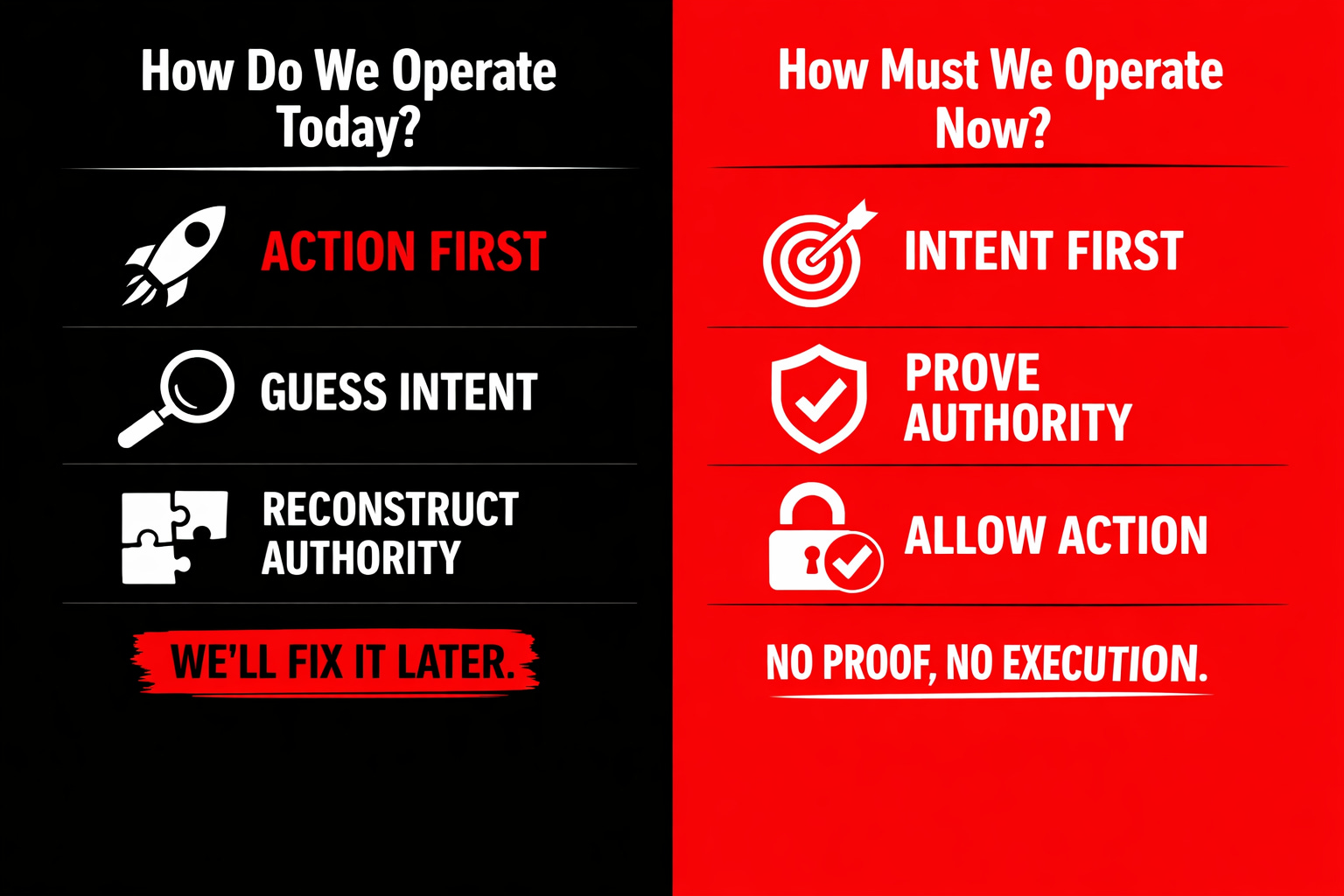
There’s a misunderstanding happening in boardrooms, engineering teams, and AI labs. We talk about AI as if it introduced a new form of risk. In reality, AI exposed a failure state that organizations have always lived with — and then finally made it possible to solve it systematically.
Here’s the blunt reality:
AI didn’t just create the problem; it revealed a gap in our governance model and finally gave us the tooling to fix it.
The Failure State That Always Existed
In most business systems today, the default assumption is:
If something can be done, it probably will be — unless someone stops it.
This is a fail-open default.
Software executes by default.
Workflows fire.
Automation runs.
AI models trigger actions.
Governance happens too late in this new world order; after the outcome has already happened.
Until recently, that was survivable because:
Humans were in the loop,
Actions were slow or reversible,
Mistakes could be rolled back,
Authority lived in email threads or tribal knowledge.
But that model is breaking down.
Where Fail-Closed Systems Are Standard
Some industries already reject this fail-open logic, because the cost of getting it wrong is so high that it simply cannot be left to chance:
Nuclear Command & Control
In nuclear forces, the system is structured so that nothing happens without explicit authorization. This is enforced through multiple safeguards:
Two-person rule: Certain high-stakes steps (like confirming a launch order in an ICBM silo) require two trained individuals acting in concert, so one person cannot act alone. This is an explicit safety control to prevent unauthorized or accidental launch. (Wikipedia)
Permissive Action Links (PALs): Nuclear weapons incorporate coded locks that must be enabled with correct authorization codes. Without them, the weapon cannot be armed even if physically accessed. These exist precisely to prevent unauthorized launches. (Wikipedia)
Gold Codes: Launch orders from the U.S. President must be authenticated via secret codes (“Gold Codes”) carried on special credential cards before any order can be acted on. The system will not proceed without this authenticated intent. (Wikipedia)
Nuclear Command and Control Architecture (NC3): Doctrine and policy explicitly design the system to ensure that only authorized employment of nuclear weapons can occur and that “unauthorized or accidental use” is prevented. (acq.osd.mil)
All of these are fail-closed mechanisms: absent the required explicit, authenticated authorization, nothing happens.
Why Business Never Adopted This — Until Now
For decades, business systems were allowed to run with implicit intent. Actions occurred because they were possible, not because they were explicitly sanctioned in a provable way.
Why?
1. Actions were reversible
Most business decisions could be fixed later. Rollback mechanisms existed. Data could be restored.
That’s no longer true:
AI actions cross organizational boundaries.
Data movement can have legal implications that cannot be “rolled back.”
Automation can propagate mistakes globally before anyone notices.
2. Intent lived in people, not systems
In traditional workflows, authority and intent were carried in minds, email threads, Slack channels, or tribal norms. That worked when:
Teams were small
Processes were slow
Humans paused before acting
Modern AI systems don’t pause. They act.
3. Velocity trumped governance
The business mantra for decades was:
“Ship first, govern later.”
That worked when execution relied on humans.
Now that systems are making decisions, the assumption that “governance gets added later” becomes untenable.
Here’s Where AI Changes the Equation
AI removes the human pause. It:
Generates actions,
Orchestrates workflows,
Acts autonomously across systems,
At machine speed.
But AI has no authority.
AI has no intent.
AI has no liability.
When AI acts fail-open, the organization inherits unbounded risk.
This isn’t an ideological critique. It’s a practical one.
The Real Safety Model Emerges from Known High-Risk Domains
AI today is exposing a truth that high-risk industries have long acknowledged:
Capability ≠ Authority.
Just because a system can act doesn’t mean it should.
In nuclear command doctrine, intent is always explicit, authenticated, and provably attached to the action before it executes — using:
Authentication codes (Gold Codes),
Multiple safeguards (PALs),
Collaborative checks (two-person rule),
Command and control protocols that ensure only authorized execution proceeds. (Wikipedia)
None of these are accidental. They exist because accidental or unauthorized nuclear action would have global catastrophic consequences — irreversible outcomes that cannot be undone.
So Why Has Business Avoided This for So Long?
Because historically:
Most business actions were reversible,
Most risk could be managed after execution,
Human judgment filled the gaps.
AI changes that calculus:
Actions are now autonomous,
Scale is global,
Consequences may be irreversible.
Thus, the same principles that govern the most dangerous systems on Earth suddenly become relevant to business workflows, data governance, and automated decisioning.
The Hard Question CEOs Should Ask
Not:
“Why would we adopt fail-closed governance?”
But:
“Which parts of our business can we truly afford to let act without explicit, provable authorization?”
If your answer is “none,” then the question isn’t whether you need this change — it’s how fast you act on it.
This isn’t about slowing the business.
It’s about making sure the business can run at speed without catastrophic ambiguity.
AI didn’t invent this challenge — it simply made it impossible to ignore.
And for the first time, we have the tooling to solve it systematically, not heuristically.
Every serious industry already has intent-before-execution control.
Synapse6 will be the first attempt to make it universal for digital systems. You haven’t seen anything yet.