


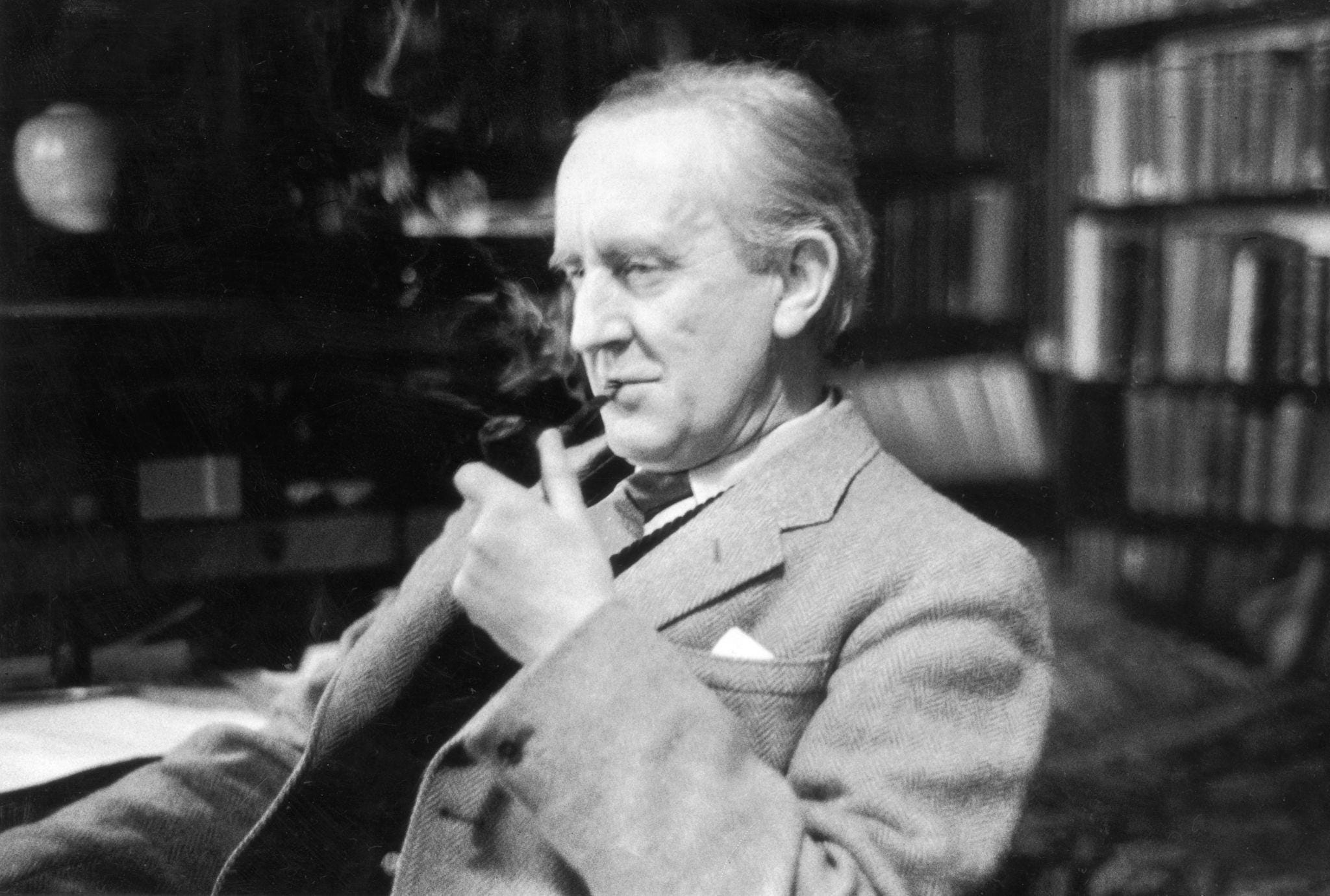
There is a small hill beyond the noise of the data centers.
It is not loud there.
No dashboards.
No pitch decks.
No “disruption.”
Just language.
If J. R. R. Tolkien were to wander into our present age, I do not think he would begin in Silicon Valley. He would begin in the Shire of our time—the quiet layer beneath the spectacle—where words are shaped before they are scaled.
Because that is where power truly lives.
The Philologist in a World of Tokens
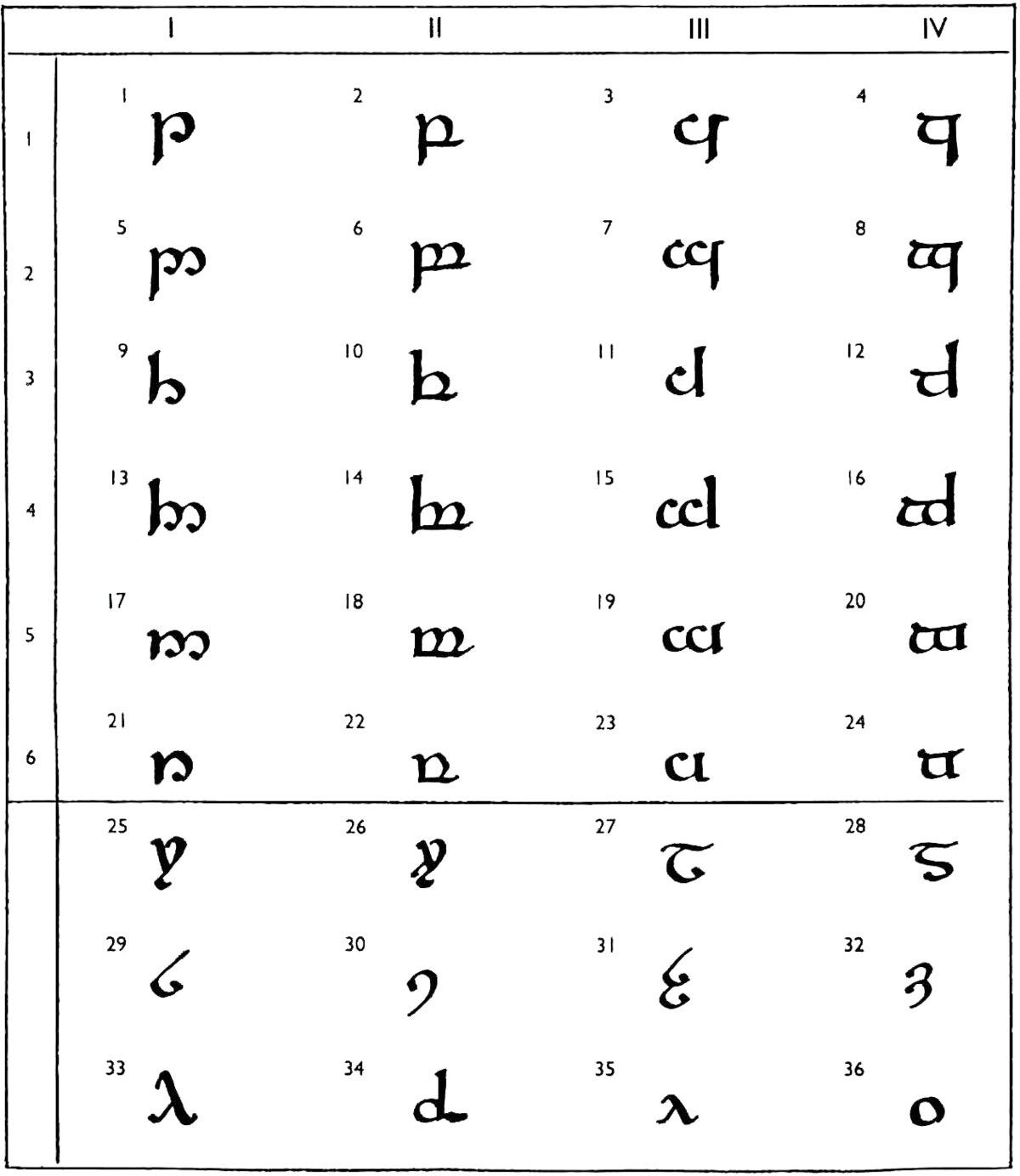
Before he wrote The Lord of the Rings, Tolkien built languages.
Quenya. Sindarin. Scripts. Sounds.
He believed story should grow from language—not the other way around.
In the AI era, we have accidentally built the largest philology machine in history.
Large language models do not begin with “intelligence.”
They begin with tokens.
Fragments of words.
Patterns of usage.
Statistical echoes of human speech.
If Tolkien walked through a modern AI lab, he would not see sorcery.
He would see morphology at planetary scale.
He would lean over a researcher’s shoulder and ask:
What is your root word?
What is your grammar?
What is your myth?
Because he understood something we are only rediscovering:
Language is not decoration.
Language is architecture.

The AI Shire
The Shire in Tolkien’s world was not naive. It was grounded. Agrarian. Rhythmic. Built on tradition and careful naming.
The AI Shire is similar.
It is the place where prompts are written with intention.
Where systems are guided through tone, cadence, structure.
Where words are tuned like instruments.
In what many now call the “vibe era,” language is not merely descriptive—it is generative.
Tone alters output.
Framing alters trajectory.
Constraint alters result.
In earlier technological revolutions, control came from hardware.
In this one, control comes from phrasing.
And Tolkien would recognize that immediately.
He knew that when you rename a thing, you reshape the world around it.
The ring is not just jewelry.
It is capital-P Power.
The Shire is not just countryside.
It is moral center.
In the AI age, a prompt is not just instruction.
It is narrative gravity.
Myth-Making as System Design
Tolkien was not writing escapism. He was constructing mythic infrastructure.
He once said that myth allows us to see truth refracted through story.
[Inference] If translated into modern language, this is not far from saying that abstraction enables cognition.
AI models operate through abstraction layers.
So did Middle-earth.
Names → Histories → Cosmology → Destiny.
Underneath it all: coherence.
The vibe era rewards those who understand this stack.
You are not just writing copy.
You are setting mythic context.
You are not just drafting prompts.
You are establishing epistemic boundaries.
Tolkien built entire ontologies before he wrote plot.
Today’s AI builders who understand language as ontology—not UI—are doing the same.
Why He Would Be Comfortable Here
He valued slow craft in a fast world.
AI rewards those who refine phrasing patiently.He believed meaning emerges from structure.
AI outputs are shaped by structure more than by raw desire.He understood that power corrupts when language is bent.
In the AI era, misaligned narratives distort systems at scale.He saw imagination as co-creation.
Readers completed Middle-earth in their minds.
Users now complete AI outputs through iteration.
He would not fear the tools.
He would question the stories we feed them.
The Heart Blood of the Vibe Era
In earlier industrial waves, leverage came from:
Steam
Electricity
Code
Now leverage comes from:
Framing
Interpretation
Narrative scaffolding
Language is no longer just a layer on top of systems.
It is the interface.
It is the steering wheel.
It is the bloodstream.
And in that sense, Tolkien was already living in our time.
He knew that whoever shapes language shapes possibility.

The Walk Home
Picture him now:
An older man in tweed, walking quietly through a co-working space filled with glowing screens.
He pauses.
Not at the GPUs.
Not at the dashboards.
But at a carefully written prompt.
He smiles.
Because he recognizes it.
Not as magic.
But as sub-creation.
And he would likely say:
Be careful what worlds you summon.
Language remembers.
And then he would return to the Shire—
which, it turns out, was never a place on a map.
It was always the discipline of naming things well.